
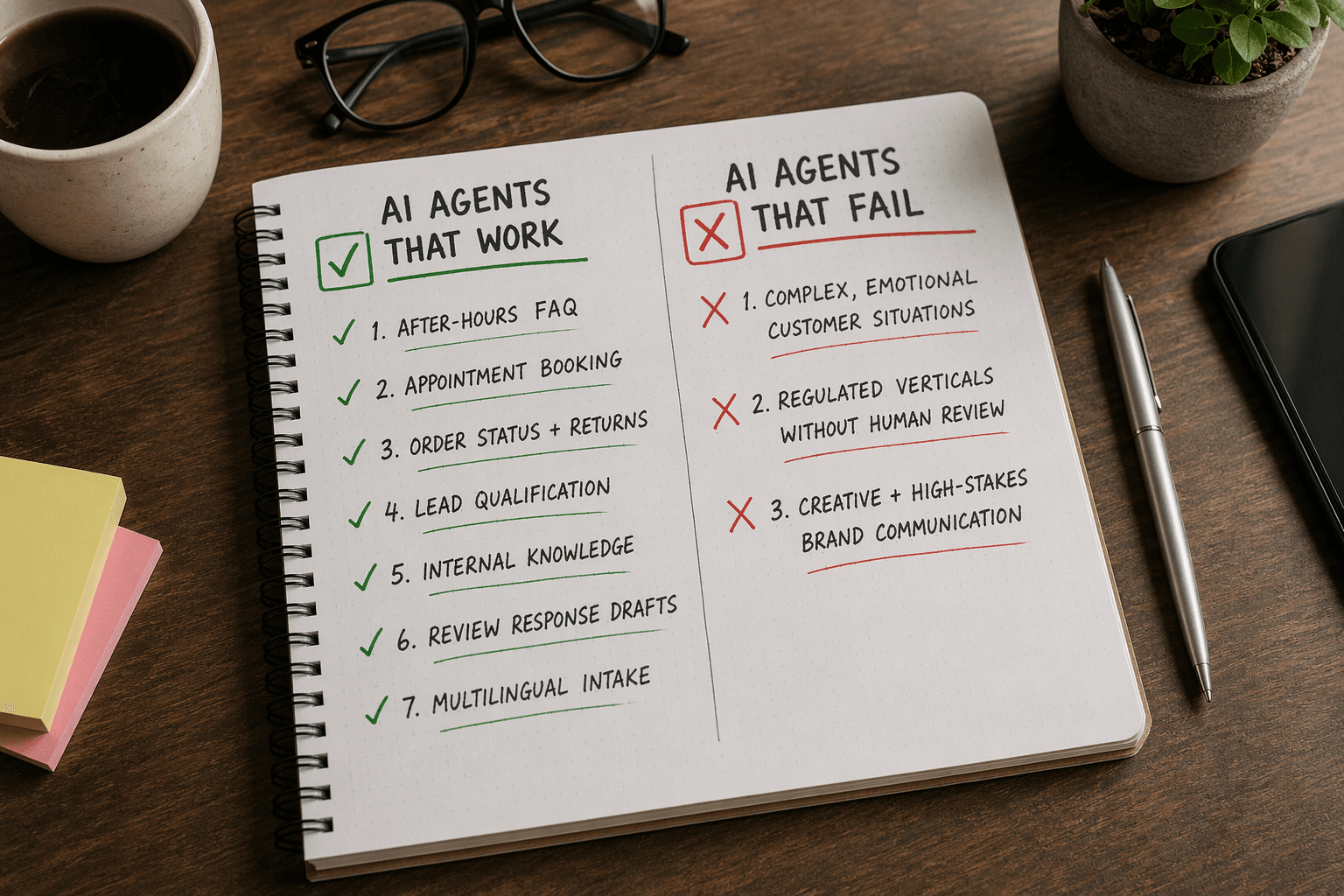
Much of the published AI-agent content reads like vendor sales copy. This evaluation does not. It walks through the real AI agents for small business use cases — seven that tend to earn their keep, three that still fail — and adds a four-part decision framework for deciding whether your business is ready to deploy right now.
Why Most AI-Agent Content Reads Like Sales Copy (and Why This One Does Not)
Much of the AI-agent content on the SERP today is produced by companies with an AI agent to sell. The tone tends toward optimism, the examples are generic, and the failure modes are often quietly missing.
That is not surprising. A vendor with a product to move has limited incentive to publish a balanced evaluation that names the conditions under which its own product is a bad fit. Honest failure analysis is a harder piece for a vendor to write without undercutting the pitch.
This post is written from a different seat. It is written from the perspective of a Miami AI automation agency, not a vendor selling a single product. Our agency deploys AI agents and AI automation services for small-business clients, and has also advised clients to wait, to pilot narrowly, or to skip the deployment entirely. Both of those data points belong in the same article.
What follows is the honest version. Seven places where AI agents tend to do real work for a small business. Three places where they still fail. A decision framework so you can tell which category you are in.
The 7 Honest Use Cases Where AI Agents Actually Earn Their Keep
These are the patterns where, in our practice, an AI agent tends to hold up past launch and keep producing value afterward — rather than sitting as a line item that decayed after the first 90 days. Each use case below answers three questions: what the agent actually does, the signal that tells you the use case is a fit, and one realistic constraint to plan for.
1. After-hours FAQ and common-question deflection
What the agent does. It answers the repetitive, low-ambiguity questions that arrive outside business hours — hours, directions, appointment policies, pricing tiers, service area, parking, what to bring, what to wear. The answers are drawn from a documented source the business approves in advance.
The signal that it is a fit. A meaningful share of your inbound messages or phone voicemails are the same questions, asked by different people, and many of them arrive after 6pm or on weekends.
One realistic constraint. The agent is only as current as the content it reads from. If your hours, pricing, or policies change and nobody updates the source, the agent will confidently repeat yesterday’s answer. Treat the source content as a living document, not a launch deliverable.
2. Appointment and consultation booking
What the agent does. It captures intent, checks calendar availability, books a slot, and sends confirmation. For businesses with multiple services, providers, or durations, the agent can route to the right calendar block.
The signal that it is a fit. Your booking logic is rules-based and explicit. You can describe it as “this type of appointment, this provider, this duration, these days of the week.” If the rules fit on a whiteboard, an agent can work them.
One realistic constraint. Complex booking logic — insurance verification, multi-party scheduling, prep requirements, conditional forms — tends to bounce to a human. Treat the agent as the front door, not the whole intake.
3. Returns, order status, and post-purchase status checks
What the agent does. It connects to your order system and answers the two questions that generate most post-purchase contact: where is my order and can I return it. Shipping updates, tracking lookups, return eligibility, basic refund status.
The signal that it is a fit. You already run an order-management system or CRM with clean, current data, and a non-trivial portion of your support volume is status lookups rather than real problems.
One realistic constraint. The answer is only as good as the source integration. If the connection to the order system breaks or the data is stale, the agent will tell customers the wrong thing with the same confidence it tells them the right thing. Monitor the integration as a first-class system, not a background utility.
4. Lead qualification at the top of the funnel
What the agent does. It takes first-touch inquiries, asks a short set of qualification questions, and routes qualified leads to the sales team while gently disengaging with the ones that clearly are not a fit. Done well, it saves the sales team from low-fit conversations without turning away prospects who could have been educated into qualified.
The signal that it is a fit. Your qualification criteria are explicit and written down. Your sales team can name the five or six signals that distinguish a good-fit lead from a bad-fit one, and those signals are things a prospect can answer in a short intake.
One realistic constraint. Qualification criteria drift. What defines a “qualified” lead in Q1 is often not what defines one in Q3 — market shifts, service changes, and pricing changes all move the line. The agent needs a review cadence, not a set-and-forget launch. This is also the point where AI-agent intake hands off to the rest of the funnel; if the downstream nurture and sales steps are weak, the agent cannot rescue them. For many service businesses, this is the first practical AI agents for marketing use case — faster intake, cleaner routing, and better handoff into the funnel. For the broader intake-to-close sequence, see our sales funnel development work.
5. Internal knowledge retrieval for staff
What the agent does. It answers staff questions against your own documentation — SOPs, product specs, warranty policies, pricing sheets, vendor contracts, refund rules, training materials. Less visible than customer-facing use cases, often more useful.
The signal that it is a fit. Staff currently spend measurable time hunting for answers in scattered drives, old emails, or Slack history. The underlying documentation exists; the bottleneck is retrieval, not creation.
One realistic constraint. A neglected knowledge base produces unreliable retrieval. If your SOPs were last updated two years ago, the agent will retrieve outdated policy, and staff tend to lose trust in it after one bad answer. Do a documentation refresh before the agent goes live, not after.
6. Drafting responses to Google reviews
What the agent does. It drafts the first-pass reply to an incoming Google review — positive or negative — in the brand’s voice and following a response framework the business has approved. A human reviews, edits where needed, and posts. The agent never posts directly.
The signal that it is a fit. Review volume is high enough that consistent, timely response has become a time sink for the owner or marketing lead, and the current response cadence is slipping.
One realistic constraint. The agent is a draft engine, not the publisher. The moment an AI-drafted reply goes public without human review, the business owns a response it did not read. Keep the human approval step in the workflow even when the drafts get good.
7. Multilingual intake for bilingual markets
What the agent does. It takes first-touch inquiries in more than one language — commonly English and Spanish in Miami-Dade and Broward service businesses, though the same logic applies in any bilingual market — and captures enough context for a bilingual human to follow up. The agent handles the intake layer; the real service work still happens with people.
The signal that it is a fit. A meaningful share of your prospects attempt first contact in a second language, your current workflow forces them through an English-only form, and your staff can continue the conversation in that second language after handoff.
One realistic constraint. Intake only. If the rest of the workflow — sales, scheduling, service delivery, billing — is single-language, a bilingual first touch creates an expectation the business cannot meet. Confirm the full path is bilingual before turning on the multilingual opening.
The 3 Places AI Agents Still Fail (and Why Vendors Don’t Highlight These)
The three failure modes below are not “considerations” or “limitations to keep in mind.” They are places where deploying an AI agent without the right human structure around it creates real downside. An honest evaluation has to name them.
1. Complex customer situations with real emotional escalation
An AI agent can answer a polite question politely. That is not the failure. The failure is in high-stakes, escalated situations — a canceled service on a wedding day, a missed medical appointment that cost the customer real money, a billing error that has compounded over three months. In those situations, the customer does not need speed. They typically need a person with authority to make a decision.
The underlying reason is structural. Current agent-class models tend to de-escalate and reassure, which can read as dismissive when the customer has a legitimate grievance that requires a judgment call. Customers in that situation often leave feeling unheard, and the public response — a review, a complaint, a share — can end up sharper than the original issue would have justified.
The practical safeguard is a fast hot-handoff to a human the moment escalation signals appear — repeated frustration language, explicit requests for a manager, mentions of refunds, or extended back-and-forth on the same issue. The agent’s job in those cases is to recognize it is the wrong tool, not to try harder.
2. Regulated verticals without a human-in-the-loop
This covers medical, dental, legal, financial, insurance, and any other vertical where a wrong answer carries regulatory or liability exposure. The technology can produce an answer quickly. The business still owns that answer.
The underlying reason is that compliance is a legal and operational question, not a technology question. Whether a specific AI-agent configuration is acceptable under HIPAA, state privacy laws, financial-services rules, or professional-responsibility standards is a determination that should be made with qualified compliance counsel — not with a vendor checklist. General guidance from the U.S. Department of Health and Human Services on HIPAA is a reasonable starting reference for medical contexts, but it is exactly that: a starting reference.
The practical safeguard is mandatory human review for any answer with compliance exposure, and a clear rule that the agent does not deliver regulated advice directly to the customer. This is the part of the evaluation worth holding firm on in vendor conversations.
3. Creative brand voice ownership and high-stakes public communication
AI agents can draft. They do not own the final public-facing voice. That distinction is doing the work.
Brand voice is a judgment call about what the business wants to sound like in public, in this specific moment, in response to this specific context. That judgment belongs to a human who is accountable for the brand. An agent can produce a solid first draft of a press statement, a crisis response, a campaign tagline, or a tone-sensitive email, and a good one will save real time. What it cannot do is be the final editor. When AI-drafted copy goes out under the brand’s name without human approval, the brand’s voice becomes whatever the model happened to produce that day.
The practical safeguard is a clear editorial rule: AI assists in drafting, humans own publication. This applies to marketing copy, review responses, social posts, and any written communication the business considers part of its public identity.
A Decision Framework: When to Deploy, When to Wait, When to Not Deploy at All
Most AI-agent decisions are not “yes or no.” They are “which, where, and when.” Four criteria cover most of the judgment.
- Volume. Is the task repeated often enough to justify the setup, the ongoing maintenance, and the human-review cadence? If a task happens twice a week, a checklist is often cheaper than an agent.
- Risk tolerance. What is the downside of a wrong answer to a customer or a staff member? Low-downside tasks are good first candidates. High-downside tasks need far more structure around them, and some should not be automated at all.
- Data readiness. Does the business have clean, current source content for the agent to work from — documented FAQs, SOPs, policies, product specs? An agent pointed at stale content will produce confidently wrong answers.
- Human-in-the-loop capacity. Does someone on the team have bandwidth to review agent output, correct it, and improve the source content over time? Without that, agents tend to degrade after launch rather than improve.
A “yes” on three or four of those criteria usually justifies a pilot. A “yes” on only one or two suggests starting narrower — a single use case, a single department, a limited rollout — or fixing the underlying data and process first. A “yes” on none of them is a signal to wait.
This is also where our AI agent implementations tend to start with clients: not with a platform choice, but with a criteria-by-criteria read of which use case actually earns a deployment right now. For Miami small businesses, that read usually starts with our AI automation for small businesses approach.
What Not to Expect from an AI Agent
- It will not replace a skilled human. The highest-judgment work still lives with people.
- It will not be set and forget. Every agent in production needs ongoing content maintenance and output review.
- It will not fix a broken process or a broken product. Automating a bad workflow tends to speed up the bad workflow.
- It is unlikely to reduce headcount in the first 90 days. Over a longer horizon, task composition can shift, but short-term headcount reduction is usually not a realistic outcome.
- It will not legally protect a regulated business from a bad answer. Compliance accountability stays with the business and its counsel.
- It will not take ownership of brand voice off the human team. Drafts, yes. Final publication, no.
- It will not stay accurate as the business changes. Updates to your services, prices, policies, or offerings have to flow into the source content the agent reads.
FAQ
Are AI agents actually ready for small business use, or is it still too early?
For a narrow set of use cases, they are ready. After-hours FAQ, appointment booking, order status, lead qualification, internal knowledge retrieval, review-response drafting, and bilingual intake are all workable patterns right now. For emotional customer escalation, regulated-industry decisions without human review, and final public-facing brand voice, they are not. Match the use case to the readiness rather than deploying by default.
What are the most reliable AI-agent use cases for a small business today?
The reliable use cases tend to share a pattern. The task is repeated often, the answers are stable enough to document in advance, the downside of a wrong answer is bounded, and a human can review and correct output over time. After-hours FAQ, booking, post-purchase status, top-of-funnel qualification, internal knowledge retrieval for staff, review-response drafting, and multilingual intake in bilingual markets all fit that pattern.
Where do AI agents still fail, and what should a small business never hand to one yet?
Three areas deserve explicit caution. Complex emotional customer situations, where empathy and judgment matter more than speed. Regulated verticals — medical, legal, financial, insurance — without a human-in-the-loop for compliance review. And final ownership of brand voice and high-stakes public communication. In each case, the failure is not that the agent cannot draft or respond. It is that the agent cannot own the outcome.
How should a small business decide whether to deploy AI agents now or wait?
Start with four questions. Is the task repeated often enough to justify setup? What is the downside of a wrong answer? Is your source content clean and current? Is there capacity to review, correct, and improve the agent’s output over time? Yes on three or four usually justifies a pilot. Yes on one or two suggests waiting, piloting narrowly, or fixing the underlying process first.
Do AI agents replace employees, and should a small business plan for headcount changes?
Not in any clean way, and rarely in the first 90 days. AI agents tend to absorb repetitive tasks that were already stretched across a team, freeing human time for higher-judgment work. Over a longer horizon, the composition of some roles may shift. Businesses that deploy agents expecting immediate headcount reduction often find the ongoing human work — content maintenance, review, correction — larger than they had budgeted for.
If Your Business Fits the Pattern
If your situation checks three or four of the decision-framework criteria — and the use case you are considering is one of the seven above rather than one of the three failure modes — a pilot is usually the right next step. If you are weighing which specific use case to start with and how to structure the human-review layer around it, that is the evaluation our AI agents for small business work is designed to run.