
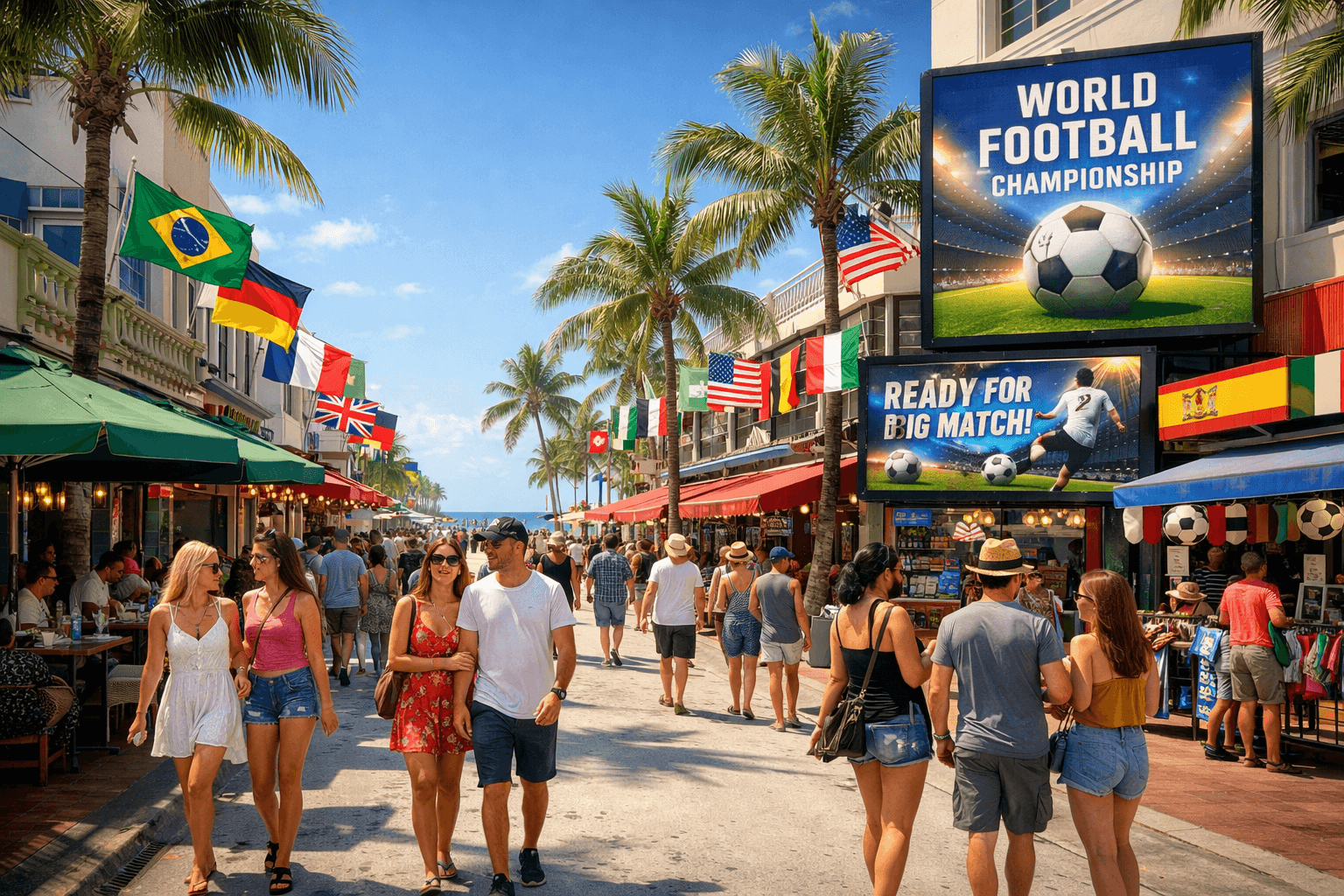
Miami doesn’t need a reminder that tourism fuels the city. What World Cup 2026 changes is the shape of demand: it arrives in a compressed window, it’s heavily mobile, it’s more comparison-driven, and it punishes businesses that wait to “turn on marketing” after the surge is already here.
This playbook is for owners and marketing leads who want a practical plan—not hype. You’ll learn how visitors actually search during major events, how to structure campaigns so your budget doesn’t evaporate on broad traffic, how to plan a ramp that protects you from last-minute bidding wars, and how to build landing pages that convert tourists who have zero familiarity with your brand.
What’s Changing for Miami Businesses as World Cup 2026 Approaches
Tourist spikes aren’t new. What’s different about a global sports event is that it creates high-intent demand from unfamiliar customers who are making quick decisions under time pressure.
That shift matters because your usual marketing assumptions break down:
- Many visitors won’t recognize your brand name, even if locals do.
- They often search from a phone while walking, riding, or waiting in line.
- They compare based on availability, distance, hours, and ease, not loyalty.
- They make “good enough” choices quickly, then move on.
If you wait until the event is underway to start learning what works, you end up paying for expensive trial-and-error during the most competitive period.
Who This Playbook Is For
This guide is designed for Miami businesses that will feel the surge directly—either because they serve visitors, or because they operate near high-traffic corridors.
Hospitality
Hotels, short-term rentals, restaurants, bars, nightlife venues, cafés, and food concepts that depend on high volume.
Attractions and experiences
Tours, boat charters, museums, guided experiences, ticketed events, day trips, and local entertainment.
Retail and local services
Souvenir shops, apparel and footwear, convenience retail, salons, barbers, med spas, transportation, parking services, and specialty services that benefit from “nearby” searches.
Multi-location brands vs. single-location operators
Both can win. The difference is how you structure targeting and landing pages—chains often need strict location control, while single locations need stronger conversion cues and clearer logistics.
The Real Search Behavior During Major Events
Tourists don’t search like locals. Locals search with familiarity (“best Cuban coffee,” “bar near Brickell”) and often already have context. Visitors search with uncertainty and urgency.
During major events, three types of intent typically spike:
1) “Near me” and proximity-driven searches
Visitors want something close right now. They often don’t know neighborhood names, so they rely on phone-based location signals.
2) “Best” and comparison searches
When visitors have time to plan, especially for attractions and dinners—they look for “best,” reviews, and credibility signals.
3) Availability and timing searches
“Open now,” “late night,” “reservation,” “tickets,” “today,” and other time-bound phrases tend to surge because visitors are scheduling around events.
This is why event-driven marketing is less about clever messaging and more about being visible for the right intent at the right moment.
Why Paid Search Becomes the Front Door During Tourist Surges
For many Miami businesses, google paid search becomes the fastest route to top-of-page visibility when competition spikes. That’s not a philosophy, it’s a practical response to how search results work during high-demand windows.
Paid search matters in this context because it allows you to:
- Control visibility immediately (instead of waiting for organic momentum)
- Prioritize high-intent queries
- Turn spend up or down based on performance and staffing
- Protect yourself from competitors who will bid aggressively
The biggest failure mode during event surges is launching a single broad campaign and hoping the algorithm sorts it out. Tourist surges reward structure and restraint—campaigns built to capture specific intent without paying for everyone who is casually browsing.
Timeline Planning: When to Start Advertising (and Why the Ramp Matters)
A World Cup surge has multiple phases. If you plan only for “when people arrive,” you miss the earlier demand that drives bookings and schedules.
A useful way to think about it is three windows:
Awareness window
People learn they’re traveling, start saving ideas, and compare options. This is when content and early paid testing can set you up for cheaper conversions later.
Booking window
Visitors start committing: reservations, tickets, tours, and experiences. This is when conversion-focused pages matter most.
Arrival window
Everything becomes urgent. This is also when costs typically rise because everyone is bidding at once and visitors are making fast choices.
A simple ramp schedule that works for many businesses:
- Pre-build: tighten tracking, build landing pages, map offers
- Pre-test: run limited campaigns to learn what converts
- Scale: increase spend as you prove profitable intent segments
- Protect: prioritize your best-performing groups; pause waste
- Extend: retarget and capitalize on secondary demand after peak
The goal is not to “spend early.” The goal is to learn early, so your peak spend is targeted and defensible.
Campaign Structure: Build Separate Campaigns for Different Tourist Intent
A strong pay per click campaign structure does not try to make one campaign serve every customer type. Tourists are not one audience. Their intent varies by urgency, category, and location.
Start with clear segmentation:
“Book now” intent vs. “plan later” intent
Booking intent should point to conversion-first pages. Planning intent can point to pages that build confidence and provide details that reduce friction.
Brand protection campaigns (even for small brands)
If your visibility increases, people will search your name. Competitors can also bid on it. A simple brand-protection campaign can prevent losing high-intent clicks.
Location-based campaigns vs. category-based campaigns
If you serve multiple neighborhoods or have multiple locations, location segmentation protects budget and improves relevance. For single locations, category segmentation often works better.
Mobile-only vs blended
During major events, mobile often dominates. In some categories, creating mobile-first campaigns (or mobile bid adjustments) helps you control experience and cost.
This is where most businesses waste money: they skip segmentation, then wonder why they get clicks but not customers.
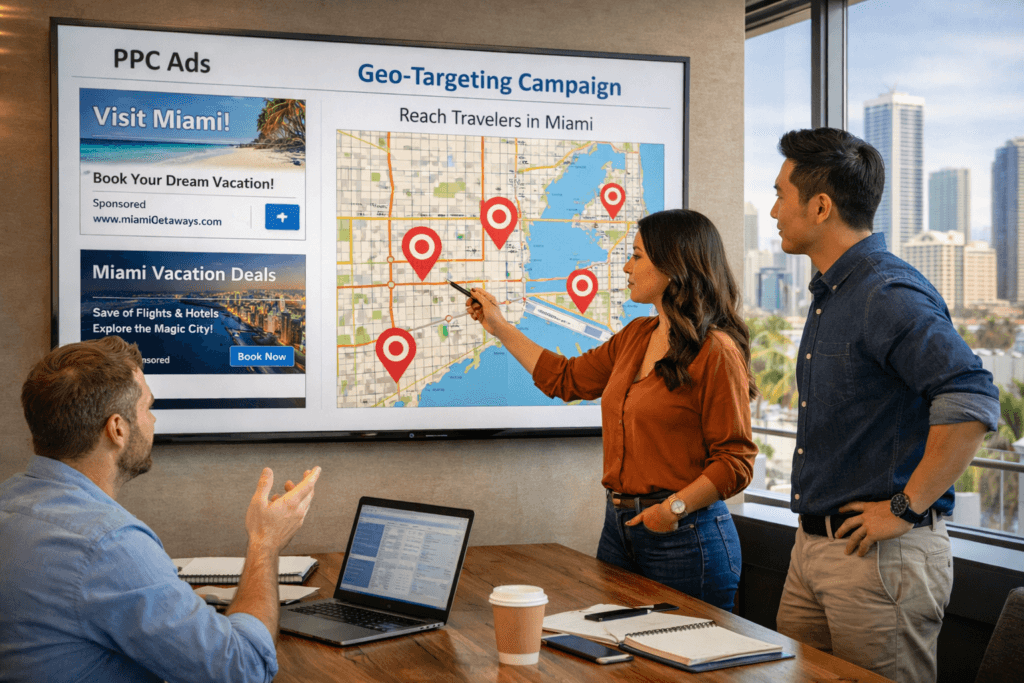
Geo Strategy: Target Travelers, Not Just Miami Residents
Tourist-targeting is not only “set Miami and run ads.” That approach reaches locals and visitors, but it doesn’t reflect how travel decisions are made.
A more strategic geo plan considers:
Where tourists are before they arrive
Many high-value decisions happen before landing. For hotels, tours, and experiences, pre-arrival targeting can matter. The goal isn’t to guess every origin city; it’s to test and identify where demand comes from.
High-traffic zones within Miami
Visitors cluster. If your business benefits from proximity searches, focus on neighborhoods and corridors that will see foot traffic—then refine based on performance.
Timing-based targeting
In the weeks leading up to the event, planning intent rises. During the event, urgency spikes. Your targeting should reflect the shift.
Common geo mistakes
- Too wide a radius (paying for irrelevant users)
- Too narrow a radius (missing nearby demand)
- No alignment between geo targeting and landing page language
Geo strategy should be designed to reduce waste, not just increase reach.
Ad Messaging That Works for Visitors Who Don’t Know You Yet
Tourists don’t have context. Your messaging has to earn trust quickly and remove uncertainty.
Prioritize clarity over creativity:
Lead with what you do and who it’s for
If someone has ten options on the screen, they won’t decode clever headlines. They will respond to direct relevance.
Emphasize availability and logistics
Visitors care about hours, location, and ease. If you offer reservations, quick booking, walk-ins, or same-day options, say so plainly.
Use trust signals carefully
If you have strong reviews, recognizable credentials, or clear proof of quality, incorporate it without sounding inflated.
Avoid generic offers
During major events, many ads look identical. Your edge often comes from specificity: what’s included, what makes the experience easier, what you’re close to, and what the next step is.
Good messaging doesn’t try to “sell the brand.” It helps a visitor make a confident choice.
Landing Pages Built for Event Traffic
If your campaigns point to a generic homepage, you’re asking tourists to do work they won’t do. Event traffic is impatient. It needs a focused path.
A World Cup landing page should do five things fast:
1) Confirm relevance
A clear headline that matches the ad intent. If you’re targeting tourists, say it plainly (without gimmicks).
2) Reduce uncertainty
Add key details visitors care about: hours, location cues, parking/transport notes, booking steps, and policies.
3) Provide proof
Reviews, short testimonials, credibility markers—kept clean and readable.
4) Make the next step obvious
Call, book, reserve, get tickets—whatever matters most—should be immediately visible, especially on mobile.
5) Prevent dead ends
Visitors should not have to hunt for pricing ranges, schedules, or availability. If you can’t show exact pricing, provide clear guidance and a frictionless way to ask.
Event pages should be built for speed and confidence, not brand storytelling.
Budget Planning: How to Spend Without Losing Control
During a major event, costs can rise quickly. That’s why budget planning should focus on guardrails, rules that protect you when competition heats up.
If you’re evaluating miami ppc services, ask whether budget planning includes:
- A strategy for prioritizing high-intent searches
- Clear negative keyword plans to reduce waste
- Segmentation that prevents one category from consuming the entire budget
- A process for reallocation based on conversions (not just clicks)
Budget tiers are useful in planning:
Minimum viable
Focus only on the highest-intent searches and the most profitable offer. You’re not trying to dominate, you’re trying to win efficiently.
Growth
Expand into secondary intent groups and strengthen landing page variations.
Aggressive capture
Cover broader intent and competitor overlap—only if conversion systems are proven and operations can handle the volume.
A budget is not just a number. It’s a decision about what demand you want to buy—and what demand you refuse to pay for.
Industry Plays: What to Run Based on Your Business Type
Event demand isn’t evenly distributed. Your category determines what “good” looks like.
Hotels and lodging
Focus on booking intent, dates, and amenities that matter to visitors. Campaigns often need strong call and form routing because visitors will decide fast.
Restaurants and bars
Near-me coverage, hours, reservation CTAs, and location cues matter more than long descriptions. Mobile-first is non-negotiable.
Attractions and experiences
Ticketing, schedules, group options, and clear “what’s included” sections are decisive. Visitors want certainty.
Retail
Don’t chase broad curiosity. Focus on high-margin products and convenience: location, hours, availability, and “visit now” behavior.
Transportation
Urgency searches dominate. Clear service area coverage and frictionless contact options matter more than long-form persuasion.
The point is not to copy a template. It’s to match campaign structure to how customers buy in your category during a surge.
Tracking and Lead Quality: Know What’s Working While It Still Matters
A major event window is short. If you can’t tell what’s working quickly, you lose the opportunity to correct course.
Track what reflects real business outcomes:
- Calls from ads and landing pages
- Booking completions or lead form submissions
- Direction requests (when relevant)
- Conversion rates by device, campaign, and keyword group
Lead quality matters as much as volume. A high click-through rate can mask low intent. During event surges, you need to identify which segments produce customers—not just traffic.
This is why segmentation and clean landing pages matter: they make the data readable. If everything is blended, you can’t tell what to scale.
Common Mistakes Miami Businesses Make During Big Tourist Events
Most failures during event advertising are predictable. They happen because businesses rush.
Starting too late
Launching during peak means paying for learning when costs are highest.
Using one campaign for everything
Broad campaigns consume budget and muddy performance signals.
Sending traffic to the wrong page
Homepages don’t convert event traffic well. Visitors need direct paths.
Ignoring mobile realities
If the page loads slowly or the call-to-action is buried, visitors leave.
Failing to protect brand search
If your campaigns create awareness, brand searches increase. Without protection, you can lose those clicks to competitors.
Avoiding these mistakes isn’t glamorous, but it’s what separates “we ran ads” from “we captured demand.”
When to Bring in Professional Help (and What to Ask For)
There are moments when professional support is not a luxury—it’s a way to avoid expensive errors during a short window.
If you’re considering a miami ppc agency, look for:
- Clear campaign architecture plans (not just ad copy)
- A testing plan before peak season
- Landing page recommendations tied to conversion behavior
- Transparent reporting that focuses on calls/bookings/leads
- A process for negative keywords and waste control
Questions worth asking before hiring:
- What is the plan for segmenting tourist intent?
- How will landing pages be structured for event traffic?
- What is the approach to geo targeting and refinement?
- How will success be measured week-to-week during peak?
Professional help is most valuable when you need speed, clarity, and decision-making, not just someone to “run ads.”
Next Steps: A Practical Checklist to Start Now
If you want to be ready before competition gets noisy, use this checklist:
- Identify your highest-margin offer for event traffic
- Decide the timeline ramp: pre-build, pre-test, scale, protect, extend
- Build an event landing page that matches tourist intent
- Segment campaigns by intent and location strategy
- Confirm tracking (calls, forms, bookings) and ensure someone can respond fast
- Set budget guardrails and a plan for reallocating spend based on results
The goal is to enter peak demand with a system you’ve already tested, not a hope that things will work out.
FAQ (Written as Normal Paragraph Text in the Final Article)
When should Miami businesses start advertising for World Cup 2026?
Start earlier than you think—not because you need to spend heavily, but because you need time to build landing pages, confirm tracking, test messaging, and identify the intent segments that convert. The businesses that win during surge windows usually learned what works before costs rose.
Should a small business run paid search if budget is tight?
Yes, if the campaign is structured narrowly around high-intent searches and a single profitable offer. Tight budgets fail when campaigns are broad. A focused approach can generate meaningful returns without trying to “cover everything.”
What’s the best landing page approach for tourist traffic?
Use a dedicated page that matches the ad intent and answers visitor uncertainty quickly: location cues, hours, booking steps, and proof. Avoid forcing tourists to navigate a full site. Event traffic converts when the path is simple and confidence is built early.
How do you target travelers who aren’t in Miami yet?
Test pre-arrival targeting where it makes sense, especially for bookable experiences and hospitality—and refine based on conversion data. The objective is not to guess perfectly; it’s to learn which segments show purchase intent before arrival and allocate budget accordingly.
What should be in ads for tourists who don’t know the brand?
Ads should be direct: what you offer, what makes it easy, and what to do next. Strong ads reduce uncertainty with clarity—hours, proximity cues, booking ease—rather than relying on clever phrasing.
When does it make sense to hire a PPC agency for an event campaign?
When timing is tight, competition is high, and you can’t afford waste. The value is in campaign structure, landing page conversion strategy, geo refinement, and rapid optimization during a short window. If you’re treating this as a major revenue opportunity, expertise often pays for itself in avoided mistakes.
Capture the Surge Without Wasting the Window
World Cup 2026 will bring attention—and competition—to Miami. The businesses that benefit most won’t be the ones that “ran ads.” They’ll be the ones that built a clear plan early, tested messaging before costs spiked, and created landing pages designed for fast tourist decisions.
If you want this surge to translate into bookings and customers, treat it like a short, high-stakes season: structured campaigns, disciplined spend, and a conversion path that works on mobile under time pressure.
If you’d like a second set of eyes on your campaign plan or landing page readiness—whether you manage in-house or work with a ppc ad agency, start with a quick audit of structure, geo targeting, and conversion flow.