
Miami is one of the most competitive markets in the country, and in 2026, websites aren’t just digital brochures — they’re revenue engines. Traffic alone no longer drives growth. What matters is whether your site can guide real people toward taking action: calling, booking, buying, or requesting information. For many small businesses in the region, the gap between getting traffic and winning customers is wider than they think.
That gap is created by design choices, loading speed, messaging clarity, visual hierarchy, trust signals, and how well the website aligns with what Miami consumers expect the moment they click. And expectations have changed dramatically since 2024–2025. Visitors want clarity faster, trust sooner, and friction reduced at every step. They’re influenced by mobile experiences, cultural familiarity, and whether the website feels like it understands how Miami actually thinks and shops.
Small changes today have outsized impact. Improving clarity above the fold, adjusting call-to-action placement, upgrading mobile responsiveness, or removing distractions can create meaningful increases in conversions. Miami small business SEO efforts may get people to the front door, but without a design built to convert, customers leave before the business ever has a chance to earn them.
In this article, we break down the strategies Miami businesses need in 2026 to transform their websites into reliable conversion machines — blending design, behavior research, CRO principles, technical performance, and local understanding.
The 2026 Customer Journey: Why Miami Visitors Bounce Faster Than Ever
What Miami Consumers Expect in 3 Seconds or Less
Miami customers are impatient — not because they’re difficult, but because they’re accustomed to fast experiences. Mobile users expect pages to load quickly, show them exactly what they came for, and build trust instantly. When a site delays or feels unclear, people assume the business behind it is outdated or disorganized.
Most users make their initial judgment before they read a full sentence. Their eyes process layout, spacing, contrast, and structure almost immediately. And when a site hesitates for even a moment, visitors assume the experience will continue to be slow.
Speed affects everything: search visibility, bounce rates, and how confident users feel about contacting the business. That is why optimizing loading time is not just a technical preference — it is a revenue decision.
Why First Impressions Make or Break Conversions
Visitors focus first on what they see above the fold: the headline, the supporting subtext, the primary call-to-action, and the layout. This opening frame determines whether they scroll or abandon.
Effective first impressions include:
- Clear value propositions
- Simple, well-structured sections
- Readable typography
- Contrasting colors that guide attention
- Visual hierarchy that points toward the desired action
Good design is not decoration — it’s direction.
What Causes Instant “Nope” Reactions?
Miami users abandon websites quickly when they see:
- Outdated or cluttered layouts
- Slow, unresponsive animations
- Stock images that don’t feel local
- Confusing menu structures
- Calls-to-action buried where no one looks
- Overly long introductory text
- Layouts that don’t adapt well to Spanish-speaking audiences
Designing for Miami: How Local Preferences Shape Winning Websites
Websites That Reflect Miami’s Culture and Bilingual Audience
Miami operates in two languages, two sets of cultural cues, and two browsing styles — English and Spanish. A website that recognizes this reality earns trust faster. Content needs to be clear, structured, and easy to understand across both languages.
Design considerations for bilingual Miami audiences:
- Logical language toggle placement
- Short, direct messaging that works in English and Spanish
- Visuals that reflect real Miami communities rather than generic concepts
Businesses that embrace cultural familiarity often convert at higher rates because users feel understood, not sold to.
Neighborhood Relevance: Why Localized Messaging Works
People in Brickell interact online differently than people in Kendall or Hialeah. Localized copy, neighborhood references, and service-area clarity make websites feel relevant.
“Serving Miami-Dade” is not enough. Users want to see:
- Neighborhood indicators
- Local proof
- Photos or examples tied to real Miami environments
Trust Signals Miami Customers Look For in 2026
Visitors in South Florida look for credibility before engaging. They want:
- Real customer reviews
- Local awards or recognition
- Social media proof
- Clear service guarantees
- Visible contact information
- Mobile-friendly booking or request forms
These elements reduce friction and support stronger conversions by building confidence at the moment of decision.
CRO Foundations Every Miami Business Needs in 2026
High-Impact CTAs That Turn Interest Into Action
Conversion-driven CTAs are simple, visible, and direct. They appear where the user naturally looks and use action-oriented language that implies clarity and simplicity.
Effective CTA practices in Miami include:
- Buttons visible before scroll
- Clear contrast between CTA and background
- Short action verbs (“Book Now,” “Get Quote,” “Call Miami Team”)
- CTAs that mirror the mobile experience
Value Propositions That Speak to Miami Buyers
Miami customers scan quickly. They want answers without digging.
A strong value proposition:
- Explains the benefit in 1–2 lines
- Shows how the business solves the visitor’s immediate need
- Communicates outcomes, not features
- Uses simple, human language
Streamlined Navigation and Clear User Flows
Fewer choices equal higher conversions. Miami users expect frictionless movement, especially on mobile.
Key flow improvements:
- Reduce menu items
- Keep CTA in consistent positions
- Use breadcrumbs for depth
- Avoid dead ends
- Keep form steps minimal
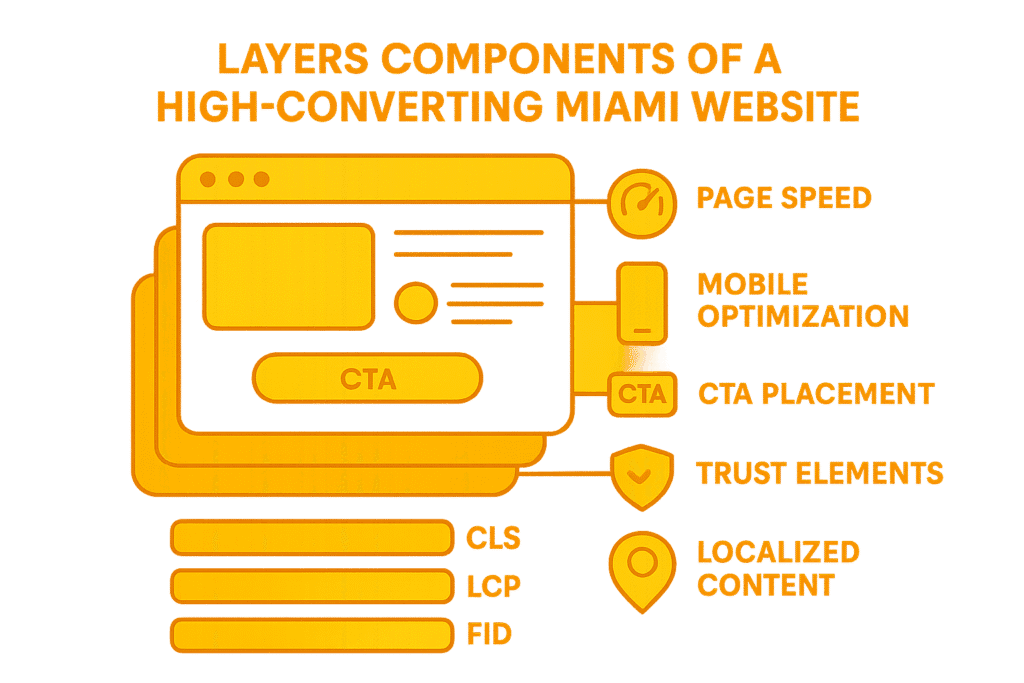
Technical Performance: The Hidden CRO Engine Behind Every High-Converting Miami Website
Mobile-First Speed Requirements for Competitive Markets
Miami’s consumer base is heavily mobile-first. Technical performance affects:
- How quickly visitors engage
- How trustworthy the experience feels
- Whether Google ranks the site competitively
Mobile responsiveness is not optional — it’s foundational.
Core Web Vitals and Why They Matter More in 2026
Businesses don’t need technical jargon, but they do need to understand impact. Smooth movement, instant rendering, and stable layout allow users to trust what they click.
Core drivers include:
- Fast rendering
- Stable elements that don’t shift
- Responsive interactions
Security and Accessibility as Conversion Drivers
Sites that feel unsafe or inaccessible fail immediately. Miami users want:
- SSL protection visible
- Clean permalinks
- Legible text and proper spacing
- Forms that screen readers and mobile keyboards handle well
The Bridge Between SEO and CRO: Why You Need Both to Win
Ranking High Means Nothing Without Conversion
SEO brings attention. CRO turns that attention into revenue. Miami businesses often invest heavily in traffic but lose customers because the site doesn’t guide them toward action.
Why CRO-Informed SEO Improves Rankings
Search engines reward strong engagement. When users stay longer, scroll deeper, and click more, rankings improve organically — making CRO a powerful SEO amplifier.
How Soaring High Connects Both Sides Into One Strategy
Soaring High unifies design, technical structure, messaging, and SEO to create a smooth path from click to conversion. It’s not about traffic volume — it’s about turning every visit into an opportunity.
Case Example: How a Miami Business Can Double Conversions in 90–180 Days
This conceptual example mirrors what many small Miami businesses experience.
The Background
A local service provider in Miami-Dade had steady traffic thanks to improved SEO but converted poorly due to outdated design and confusing mobile layout.
The Core Problem
Visitors reached the site but hesitated because:
- Calls-to-action were inconsistent
- The mobile menu was cluttered
- Trust indicators were buried
- The value proposition lacked clarity
What Soaring High Implemented
- Redefined above-the-fold messaging
- Simplified navigation
- Added clear trust assets
- Streamlined contact options
- Improved local relevance on key pages
- Integrated CRO-supported SEO structure
The Outcome
Within a few months, engagement increased noticeably, contact form submissions multiplied, and phone inquiries became consistent. This result was not due to one change — but the combination of structured design, local relevance, and improved conversion pathways.
A Breakdown of the 10 Most Common CRO Mistakes Miami Businesses Still Make in 2026
- Cluttered hero sections
- Weak or hidden CTAs
- No mobile-first design
- Walls of unorganized text
- Slow hosting choices
- No visible reviews
- Overcomplicated menus
- Poor spacing and readability
- Missing neighborhood relevance
- Design styles that feel outdated
FAQs: Clear Answers for Miami Business Owners Focused on Conversions
1. What makes a website “high converting” in Miami?
Clarity, speed, strong CTAs, mobile experience, local relevance, and trust signals.
2. How long does CRO take to show improvements?
Most businesses begin seeing meaningful engagement improvements within weeks after structured changes.
3. Do Miami businesses need bilingual content for conversions?
It depends on the audience — but Miami’s consumer base often converts more reliably when both languages are acknowledged.
4. How often should a website be redesigned?
Many businesses see improved results when they refresh design elements every 24–36 months.
5. What matters more: design or SEO?
Both. SEO brings the visitor. Design and CRO convert them.
6. Why do some sites get traffic but no conversions?
Usually because messaging is unclear, UX is weak, or CTAs don’t guide the user.
7. How do I know if my CRO strategy is working?
When engagement improves, form submissions increase, and bounce rates decline.
Final Thoughts: Why 2026 Will Reward Businesses That Invest in UX and CRO
Miami’s online marketplace is evolving quickly, and businesses that rely only on traffic are falling behind. The real advantage comes from combining clear design, strong structure, performance, and local connection. Those who update their sites today position themselves for long-term success.
Work With a Web Design Partner That Understands Miami’s Digital Behavior
Soaring High Marketing Solutions brings together UX, CRO, web design, and local SEO intelligence to help Miami businesses build experiences that earn trust and convert consistently. With a structured approach, cultural awareness, and continuous optimization, we support businesses that want their websites to become dependable engines for growth.