

If you’ve spent any time searching for SEO help in Miami, you already know the problem. The options are overwhelming and the promises are nearly identical. Every agency in South Florida will tell you they rank businesses on page one, deliver transparent reporting, and use only white-hat methods. The claims are interchangeable. The results are not.
This guide walks you through exactly what to look for when evaluating a Miami SEO firm — and the warning signs that should stop you from signing a contract before you’ve asked the right questions.
The SEO Landscape in Miami Is Different From Most Markets
Miami isn’t a soft market for search engine optimization. You’re competing in one of the most multilingual, densely populated metro areas in the country, with searchers who frequently use Spanish-language queries, near-me mobile searches, and hyper-local intent terms. An SEO firm that succeeds in a smaller metro doesn’t automatically translate that success to Miami.
The top-tier verticals — legal, medical, real estate, home services, hospitality, financial services — are contested by businesses that have been investing in SEO for years. Catching up requires a firm that understands the competitive map, not one applying a generic checklist regardless of market.
What a Legitimate Miami SEO Firm Should Be Able to Show You
Before any contract conversation, a credible SEO agency should be able to give you specific, verifiable answers to these questions:
Can You See Their Keyword Ranking Data?
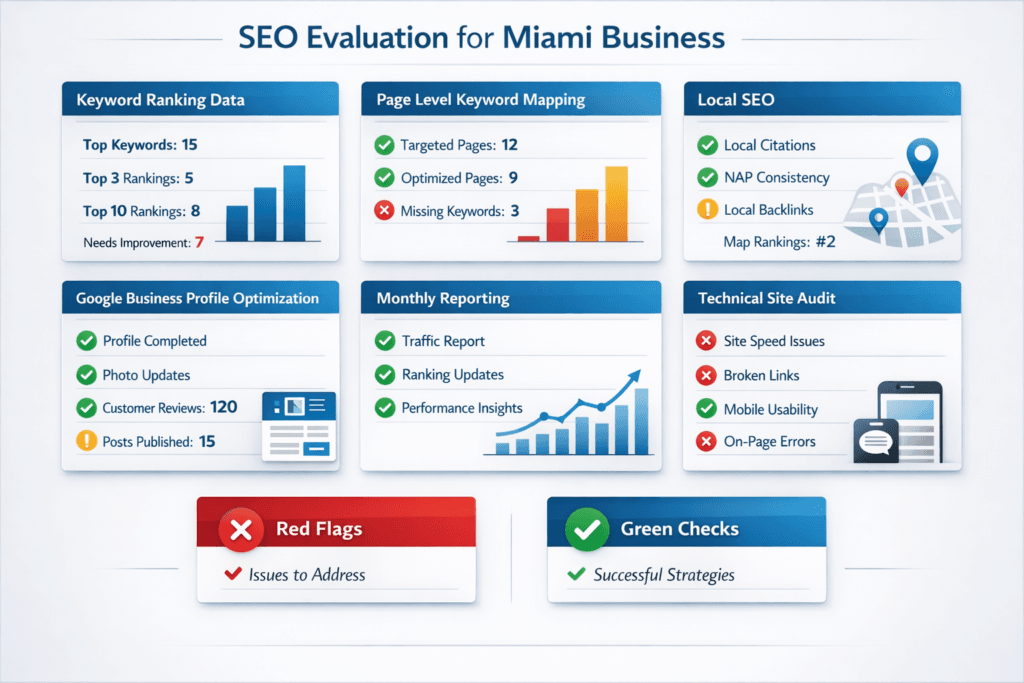
Any agency worth hiring has live tracking dashboards for their clients. Ask to see anonymized examples — position histories, keyword movement over time, impression data from Google Search Console. Vague references to “improved rankings” without data aren’t results. They’re talking points.
Do They Assign One Clear Keyword Cluster Per Page?
A common mistake — and a sign of disorganized SEO work — is when an agency targets the same keywords on multiple pages, creating cannibalization that Google penalizes. Ask them how they decide which keywords go on which pages and how they prevent overlap. If they can’t explain their page-level keyword architecture clearly, their strategy has gaps.
Do They Include Local SEO Specifically?
Search engine optimization in Miami requires local SEO work — Google Business Profile optimization, citation building, review strategy, localized landing pages — not just technical on-page changes. If a firm is offering “SEO services” without explicitly addressing the local map pack, you’re paying for half a strategy. For Miami businesses that depend on local customers, local SEO services are a non-negotiable part of the work.
What Does Reporting Actually Look Like?
Monthly reports should include keyword position changes, GSC impressions and clicks, GBP performance metrics, and a clear next-step recommendation. If their reporting is a PDF of vanity metrics — domain authority, spam score — without showing actual ranking and traffic movement, that’s a red flag.
Red Flags That Should Give You Pause
Some warning signs are obvious. Others are buried in the language agencies use when they pitch.
Guaranteed Rankings
No legitimate SEO firm guarantees page-one results. Google’s algorithm is not controllable by anyone outside Google. Any agency that guarantees specific rankings within a set timeframe is either misrepresenting how SEO works or planning to use tactics that will hurt your site when Google catches up.
Pricing That’s Suspiciously Low
Real SEO work — keyword research, on-page optimization, technical audits, content development, citation management — takes time. If a firm is offering full SEO services for $200 to $500 per month, either the work is superficial or it’s being outsourced to the cheapest possible contractor with no accountability. Effective SEO in a market like Miami costs more than that.
No Mention of Content
Google ranks pages, not websites. For a page to rank, it needs content that matches search intent, addresses the topic thoroughly, and is structured so Google can understand it. An agency that doesn’t discuss content strategy as part of SEO is working without one of the primary ranking levers.
They Can’t Explain Their Technical Audit Process
Before an agency builds content or chases links, they need to know the technical state of your site — crawl errors, indexation problems, canonical issues, page speed, mobile usability. If they skip straight to “we’ll optimize your pages,” ask what they found in the technical audit first. If there wasn’t one, that’s a problem.
Questions to Ask Before You Sign
Use these as your qualification filter. A strong agency will welcome every one of them. A weak one will deflect.
- What specific keywords are you targeting on my site, and what page will each one rank on?
- How do you structure keyword-to-page assignments to avoid cannibalization?
- What does your local SEO work include — Google Business Profile, citation building, review management?
- Can you show me an example of the monthly report a current client receives?
- What would your technical audit of my site involve, and what are you looking for?
- How long before I should expect to see meaningful ranking movement?
- How do you handle keyword tracking and what tool do you use?
Why Local Experience in Miami Specifically Matters
Miami-Dade is not a single competitive market — it’s a collection of them. Brickell, Doral, Coral Gables, Hialeah, Aventura, Miami Beach, and Kendall are each distinct search environments with different competitor sets, different consumer demographics, and in some cases, different language dynamics. Doral and Hialeah have significant Spanish-language search volume that Brickell or Coconut Grove may not.
A Miami SEO firm that has worked across these neighborhoods understands this. One applying a copy-paste framework from a different market doesn’t, and the gap will show up in your results. The same applies to South Florida more broadly. If your business serves Broward or Palm Beach County alongside Miami-Dade, your strategy needs to address those markets distinctly — separate content and geographic targeting, not an assumption that Miami content carries authority everywhere. See how we approach South Florida SEO for businesses operating across all three counties.
What Realistic SEO Timelines Look Like
Set expectations clearly before you start. For most businesses in competitive Miami verticals, meaningful ranking movement takes three to six months of consistent work. “Meaningful” means measurable — position improvements in Google Search Console, increased impressions, organic traffic growth — not necessarily page-one results on your most competitive terms from day one.
Businesses that see faster movement typically have clean technical foundations, no pre-existing penalties or hacked content, and are targeting keyword clusters in the 50 to 500 monthly search volume range rather than chasing terms where the competition is years ahead. For businesses dealing with legacy technical issues — hacked content, indexation problems, crawl errors — the first phase of work is remediation, not ranking. That groundwork has to be done before content work delivers its full impact.
Ready to Talk to a Miami SEO Firm That Shows You the Work?
At Soaring High Marketing Solutions, every engagement starts with a data-backed audit — not a sales pitch. We show you exactly where your site stands, which keywords represent real opportunities, and what it will take to compete.
If you’d rather skip the firm-evaluation process and start with a Miami SEO team that already runs this playbook for local businesses, see our Miami SEO services for service businesses across Miami and South Florida.
→ Book a free SEO strategy call and get specific answers, not generic promises.