

When visibility looks fine but bookings flatten
A plateau is not a mystery, it is a system signal
If you run a med spa or a home services business in Miami Dade or Broward, you have probably lived through this exact moment: the ranking report looks okay, your website traffic does not look alarming, and your Google Business Profile still appears when you search your brand name, but calls slow down and bookings flatten.
That is what a local SEO plateau feels like. It is not always a dramatic drop. It is often a slow stall where performance stops compounding. You keep publishing, you keep “optimizing,” you keep paying, but the system does not produce more qualified leads.
This matters because the businesses that win in South Florida are rarely the ones doing one clever tactic. They are the ones whose entity, location, and intent signals stay consistent under pressure, month after month, while competitors drift. When those systems degrade, visibility can look stable while demand quietly fragments.
This article is not a recap of generic local SEO tactics. It is a diagnosis of failure modes that cause pages and listings to stall specifically in Miami Dade and Broward, where competition punishes weak signals faster than most markets. It is written for decision makers who need local visibility to turn into calls, consult requests, and scheduled jobs without guessing.
The thesis is simple: plateaus usually happen when entity and location systems are ignored. Google’s local ranking model is still built around relevance, distance, and prominence. When your business identity and location understanding weaken, those three inputs stop working in your favor, even if you keep doing surface level “SEO work.” (Google Help)
If you want a practical way to apply this, start with the fundamentals of local SEO in Miami and then zoom out to the competitive environment that defines South Florida SEO strategy.
South Florida is an edge case market for local search
Miami Dade and Broward behave like edge case markets for local search because customers move across city lines constantly, service areas overlap, multi location brands compete with single operators, and “near me” intent can shift by neighborhood, time of day, and urgency.
For med spas, trust and clarity decide whether someone books a consultation or bounces to the next listing. For home services, speed, service area accuracy, and call handling decide whether a lead turns into a dispatch or a dead end.
So the goal here is not to promise outcomes. It is to show what to measure and what to fix next, in a sequence that replaces random tactics with an audit driven plan.
What changed recently and why it matters now
Local results are more crowded and more enforced
Plateaus are more common now because the local results environment is more crowded and the enforcement environment is less forgiving. Even without chasing rumors, you can see the direction clearly in Google’s own documentation: local visibility depends on relevance, distance, and prominence, and your listing information needs to be accurate and complete to show appropriately. (Google Help)
At the same time, policy compliance has become a bigger operational requirement. Google publishes prohibited and restricted content policies for Business Profile related content and behavior, including restrictions around deceptive behavior and incentivized engagement. Businesses that treat reviews and listing management casually can end up with missing content, restrictions, or other trust signals that weaken performance. (Google Help)
This matters in South Florida because aggressive categories amplify every weakness. When competitors fight for the same “near me” moments, even small inconsistencies in categories, services, or business details can shift who gets the call.
SERP layouts fragment demand across surfaces
Another reason plateaus happen is that demand fragments across multiple surfaces. A customer might discover you in the local pack, compare you to directory listings, read reviews, click your website, then call from the listing instead of the site. If your measurement only tracks website form fills, your “SEO report” can look fine while your real lead flow changes shape.
In Miami Dade and Broward, “near me” behavior increases both growth opportunity and spam pressure. Google’s policies explicitly address manipulative behavior and content that does not represent genuine experiences, which is part of why clean governance matters more than clever shortcuts. (Google Help)
If your plateau is tied to local assets, not just pages, you will usually see it first in your Google Business Profile performance. That is why the fix often begins with Google Business Profile optimization and listings consistency, alongside the broader work inside your local SEO service in Miami.
The system Google evaluates: entities, locations, and intent
Entity consistency across web, listings, and site
In local search terms, an entity is your business as Google understands it. It is not only your website. It is your Business Profile, your citations, your review footprint, your directory mentions, and the consistency of your identity signals across the web.
Google’s Business Profile guidelines are direct about the requirement to reflect your business accurately and avoid prohibited behavior. That implies a real operational responsibility: your business name, address, phone, and category level identity must be consistent across the sources that shape local trust.
Entity consistency includes:
• Stable business name usage, no keyword stuffing variations
• Consistent address formatting for location based businesses
• Consistent phone routing and primary number logic
• Consistent category and service descriptors between your listing and your website
• Citations that reinforce the same business identity instead of drifting over time
When those signals are aligned, Google can confidently match your business to relevant local searches. When they drift, your prominence and relevance signals weaken in practice, even if your site pages are technically “optimized.”
Location understanding at page and brand level
Location understanding is not only your address on the contact page. It is how your brand and each page communicates geography in a way that matches real customer intent.
For storefront businesses, location understanding includes accurate address signals and consistent placement across site templates. For service area businesses, location understanding includes a truthful representation of where you serve, how you describe that service area, and how your pages map services to the right cities without creating thin, duplicative content.
Google’s local ranking basics emphasize distance as a factor, which is why accurate location data matters. If your listing suggests one set of locations and your site suggests another, you invite ambiguity.
In Miami Dade and Broward, ambiguity is the enemy. Customers regularly search across city boundaries, and service radius expectations vary by category. A plumber’s effective service area may differ from a med spa’s practical draw radius, and your content architecture should reflect those realities.
Intent matching in local: service, location, urgency
Local intent is usually a combination of three signals:
• Service intent, what the customer needs
• Location intent, where they need it
• Urgency intent, how soon they need it
This is why “miami fl seo” and “seo optimization miami fl” content that is too generic can stall. It may rank for broad discovery, but it will not always capture service specific, city specific, urgency driven searches that produce calls.
For med spas, intent is often consult driven and trust weighted. Customers want clarity about the service, the credibility of the provider, and an easy path to book. For home services, intent is often urgency driven and logistics weighted. Customers want immediate confirmation that you serve their area and can respond.
Pages stall when tactics are strong but system signals are weak. You can publish more pages, build more links, or tweak title tags, but if the entity and location systems are inconsistent, the plateau persists because the foundation is still unstable.
To see what these systems look like when implemented deliberately, review how local SEO in Miami is positioned alongside broader South Florida SEO strategy.
Failure modes that stall Miami Dade and Broward visibility
Duplicate location architecture and cannibalization
One of the most common plateau causes in South Florida is duplicated location architecture. Businesses create dozens of city pages that share the same template, the same paragraphs, and the same service list with only the city name swapped. The intent is understandable, capture more cities, but the result is often internal competition and thin relevance.
Here is how cannibalization shows up:
• Multiple URLs targeting the same service and same city intent
• A service page and a city page fighting for the same queries
• Several city pages ranking briefly, then swapping positions month to month
• Search Console showing impressions spread across many pages with low click through rates, instead of one strong page winning consistently
This failure mode intensifies in Miami Dade and Broward because competition forces Google to choose. When many pages look the same, the system has fewer reasons to trust any one page as the best match.
The fix is not always “delete pages.” It is to decide what your location model is:
• A hub model, where strong service pages cover geography through robust sections and internal links
• A selective city model, where only the most meaningful cities have deep, unique pages
• A multi location model, where each physical location has truly distinct local proof, staff, photos, and offerings
This is where strategy beats templates. The right decision depends on your operations, not on a generic playbook.
Weak relevance signals on service plus city pages
When city pages stall, the problem is often not backlinks. It is relevance.
Weak relevance looks like:
• A page headline that is vague, like “Services in Miami”
• Service descriptions that are broad and interchangeable
• No local proof signals, no neighborhood context, no operational clarity
• No page level focus, everything is listed, nothing is prioritized
• No clear conversion path for the service intent
Relevance in local search is about how well your business matches the query. Google explicitly describes relevance as part of local ranking, which is why page level specificity matters. (Google Help)
In med spa categories, relevance also includes trust framing. If the page reads like generic marketing copy, customers hesitate. In home services, relevance includes dispatch clarity. If the page does not confirm service area and service type quickly, the lead goes elsewhere.
A strong local page does not try to rank for everything. It tries to be the best answer for a specific service and a specific local intent cluster.
Inconsistent entity data and citation drift
Citation drift is a plateau machine. It happens slowly:
• A phone number changes, but some directories keep the old number
• A suite number is written differently across platforms
• The business name is shortened on some profiles, expanded on others
• Hours are updated on one platform but not another
• A practitioner or department name starts appearing as if it were a separate business
Google’s guidelines for representing your business emphasize accurate representation and compliance with policy. When your entity data is inconsistent, you reduce trust, and you introduce ambiguity that can suppress performance under competitive pressure.
In Miami Dade and Broward, drift matters more because competitors are often running tighter operations. When everyone is strong, the market exposes any weak signal, especially in the map results where trust signals play a major role in who gets chosen.
The fix is boring but powerful: a quarterly entity consistency audit that covers Business Profile fields, core directories, and on site NAP placement, plus a change control process so updates propagate correctly.
Service area confusion and category mismatch
Service area confusion is another common stall driver, especially for home services.
It shows up when:
• Your site claims broad coverage, but your Business Profile service area is narrow
• Your listing suggests you are located in a city where you do not actually operate
• Your service pages reference neighborhoods you do not serve
• Your contact page and footer suggest different cities
Accuracy matters because distance and relevance are fundamental local ranking components. If your service area representation is inconsistent or misleading, you risk both performance issues and policy issues.
Category mismatch is related. Your Business Profile categories are a strong relevance signal, and they should align with your on site language. When your profile says one thing and your site says another, your system signals fracture.
For med spas, category and service alignment influences the types of searches you appear for and the trust customers feel when they land on your pages. For home services, category mismatch can attract the wrong calls, for example, general inquiries instead of emergency intent, which makes the plateau feel like “lead quality got worse.”
These problems intensify in South Florida because the market is aggressive. Competitors with cleaner alignment win, not because they have a secret trick, but because their entity and location systems reduce ambiguity.
If you want a disciplined approach to preventing drift, anchor your local work around Business Profile and listings consistency and keep it integrated with your local SEO in Miami plan and your broader South Florida SEO strategy.
Competitive pressure: what breaks first when the market is aggressive
Review systems, trust, and policy boundaries
In Miami Dade and Broward, trust is not a soft concept. It is a conversion filter.
Reviews shape trust in two ways:
• Customers use reviews as a fast credibility shortcut
• Reviews influence engagement behavior, which affects the chance a customer calls or books
But the policy boundary matters. Google’s prohibited and restricted content policies explicitly address deceptive behavior and content that is not based on genuine experiences, including content posted due to incentives. If your review practices cross the line, you can trigger restrictions that damage trust signals and create long recovery cycles.
Professionals treat review generation like a compliance governed system:
• A consistent request process after legitimate service
• No incentives, no gating, no selective filtering
• Clear internal rules for staff responding to reviews
• A cadence for monitoring, responding, and escalating issues
If you want a deeper tactical guide focused on home services, see Mastering Google Business Profile for Miami home services companies, then align it with your ongoing reputation processes through reputation management.
Directories, aggregators, and local pack crowding
Another pressure point is directory dominance. In crowded categories, directories and aggregators often occupy valuable visibility, and they compete directly with your site pages for clicks.
You cannot “out directory” a directory with a thin page. The way you compete is by building service pages that outperform aggregators through:
• Clear service definition and scope
• Local operational clarity, areas served, response expectations
• Strong conversion paths, call, booking, consult requests
• Content depth that answers real buyer questions
• Internal linking that guides users to the next decision
For med spas, this means pages that educate without fluff and make the consult path obvious. For home services, it means pages that reduce uncertainty quickly and create confidence to call now.
In aggressive markets, the first thing that breaks is usually not rankings. It is clarity. When your pages are not the clearest answer, you get fewer calls even if visibility looks stable.
Measurement reality: what metrics lie, what metrics help, and why
Local visibility metrics that mislead
Local markets punish shallow measurement. Generic ranking snapshots mislead because local results shift by:
• Neighborhood and proximity
• Device type
• Time of day
• Query wording and intent
• Local pack versus organic surfaces
If your reporting is mostly “average position” and a handful of tracked keywords, you can miss the real issue, which is that query mix and conversion behavior changed.
Search Console is useful here because it reports clicks, impressions, and position by query and page, and it can show when impressions rise while clicks and conversions flatten, a common plateau pattern.
Signals that correlate with real calls and bookings
Instead of chasing vanity metrics, measure signals that map to outcomes.
For med spas:
• Consultation request submits and booking starts
• Calls tagged as consult intent
• Branded search lift, showing demand growth
• Query mix shifts toward treatment and consult intent
For home services:
• Qualified calls by service type
• Calls by service area, including misrouted lead volume
• Time to first response and missed call recovery rate
• Query mix shifts toward urgency intent, such as emergency, same day, open now
Add Google Business Profile performance metrics into the system:
• Calls from the profile
• Website clicks from the profile
• Direction requests, when relevant
• Message interactions, if enabled
Google’s documentation explains that Business Profile owners can review performance such as views and customer interactions in Search and Maps, and that these metrics help track how people interact with your profile.
Diagnostics that reveal where the system is failing
A local plateau is easier to fix when you can name what is stalling.
Use diagnostics to separate:
• A page stall, where specific service pages stop growing in clicks and high intent queries
• A listing stall, where Business Profile interactions flatten or decline despite stable impressions
• An entity stall, where inconsistencies across citations and profiles reduce trust and relevance
Here is a practical measurement spec that makes the plateau auditable:
- Search Console query monitoring by service and city intent
Track queries that combine service and location modifiers and watch for query mix shifts, not just totals. - Business Profile performance review cadence
Weekly checks for interactions, monthly rollups for trends, and notes tied to operational changes. - Call tracking governance
Define qualified call criteria, tag call outcomes, and audit routing quarterly so you do not lose attribution. - UTM consistency
Use consistent tagging for website links from profiles and campaigns so you can separate true channel performance from tracking noise. - Architecture and entity change logs
Any time you edit location pages, categories, services, phone numbers, or hours, log it, so you can connect changes to performance shifts.
The goal is not to promise outcomes. It is to ensure you can prove what changed, what is failing, and what to fix next.
If your visibility is stuck, Soaring High can run a local entity and location audit and show which specific signals are missing for your category.
Start with local SEO in Miami and pair it with a Business Profile focused review through Google Business Listings support.
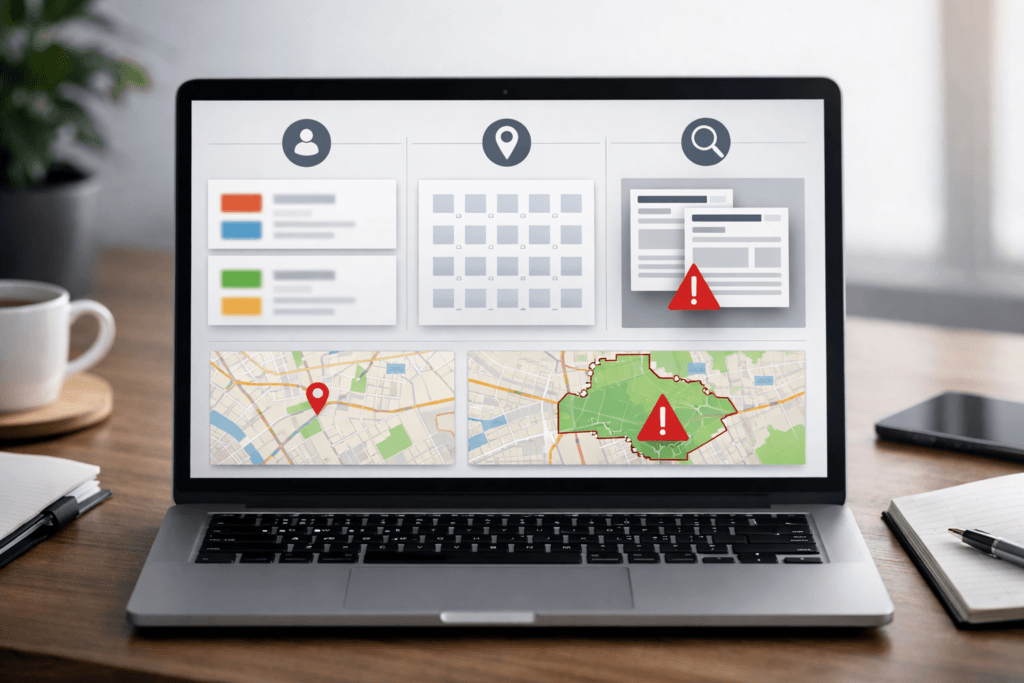
Decision framework: the fix sequence that prevents random tactics
Stabilize the entity first
Professionals fix plateaus in an order, because the wrong order creates rework.
Phase one is entity stabilization:
• Confirm exact business name usage and eliminate variations
• Align primary phone number and call routing logic
• Audit Business Profile fields for accuracy and policy alignment
• Correct top citation sources and major directory drift
• Document categories and services so site language matches listing language
This phase matters because local ranking is influenced by relevance and prominence signals, and your entity consistency supports both. (Google Help)
Done looks like:
• A single source of truth document for NAP and descriptors
• Business Profile fields aligned with that source of truth
• Top citations corrected and monitored
• A change control process so drift does not return
Repair location architecture second
Phase two is location architecture repair. This is where you decide whether your city pages should be consolidated, rebuilt, or reduced.
Tradeoffs you must evaluate:
• Consolidation can reduce cannibalization but requires deeper pages
• Expansion can capture more cities but increases thin page risk
• Multi location brands need location pages that are genuinely distinct and operationally accurate
Done looks like:
• A documented location model, hub, selective city, or multi location
• A revised URL map that removes internal competition
• Page templates that include local proof signals and clear conversions
• Internal linking that guides users from service discovery to booking
If conversion improvements are part of your fix, align the architecture work with web design services in Miami so the conversion path is built into every template, not patched later.
Improve relevance and conversion last
Phase three is relevance and conversion refinement:
• Rewrite pages so each one owns a specific service and location intent
• Add clarity that reduces lead friction, service area, response expectations, consult flow
• Strengthen trust signals, reviews integration, team or expertise signals where appropriate
• Improve conversion surfaces, tap to call, booking prompts, form friction reduction
Done looks like:
• Each priority page has a clear intent statement
• Each page has a measurable conversion action
• Call and booking tracking is tied to page intent
• Misrouted leads decrease because service area and services are explicit
You are not chasing magic. You are removing ambiguity. In South Florida, that is often the difference between stable visibility and compounding visibility.
For businesses that want a wider strategy lens, connect these fixes to a broader South Florida SEO plan so the local system supports the full market reality.
E-E-A-T pack: credibility, editorial standards, and fact checks
Author and credentials
Byline suggestion
Senior Local SEO Strategist, South Florida market experience, responsible for local audits, entity cleanup, location architecture, and measurement implementation for med spas and home services.
Editorial standards
This article follows a policy first approach:
• No fabricated outcomes
• No anonymous testimonials
• No unsupported superlatives
• No claims about specific ranking results without first party data
• Platform rules and documentation take priority over tactics
Fact checking checklist
Before publishing, confirm:
• Every platform rule referenced matches the cited Google documentation
• Every measurement recommendation is observable in Search Console or Business Profile performance views
• Every statement about what causes plateaus is framed as a failure mode, not a guarantee
• No claims imply inside knowledge of algorithm updates beyond published documentation
• Internal links point to the correct service pages and supporting resources
Primary sources only are used when discussing platform policies and local ranking model concepts.
FAQ
Local SEO Miami why is my traffic not turning into calls?
Because traffic is not the same as local demand. A plateau often means your query mix shifted toward informational searches while high intent local searches stayed flat. Use Search Console to compare queries driving clicks to pages versus the pages you need to produce calls, then validate whether calls are coming from the site or the Business Profile.
Miami FL SEO why do city pages stop ranking?
City pages often stall because they compete with each other, lack unique local relevance, or do not align with how Google evaluates relevance, distance, and prominence. If many pages look similar, the system has fewer reasons to rank one consistently.
SEO optimization Miami FL What should be fixed first?
Fix the entity first. Align Business Profile fields, NAP consistency, categories, and core citations. Then fix location architecture. Only after those are stable should you invest heavily in content expansion and conversion refinements. This order reduces rework and prevents chasing symptoms.
South Florida SEO why does near me change month to month?
Because local intent is context sensitive. Proximity, competition, and query wording shift constantly, and results can vary by neighborhood and device. That is why professionals track query mix and profile interactions over time, rather than relying on a static rank snapshot.
Google Business Profile why did my visibility drop?
Common causes include inaccurate business info, category or service changes, inconsistent citations, policy violations, or competitors strengthening their trust signals. Google’s guidelines emphasize accurate representation and avoiding prohibited behavior, and policy enforcement can impact what is shown. Review your Business Profile performance trends alongside recent changes and policy compliance.
How do relevance distance prominence affect local rankings?
They are the core components Google describes for local ranking. Relevance is how well a business matches the query, distance relates to proximity, and prominence relates to how well known or authoritative the business appears. Plateaus often happen when relevance and prominence signals weaken due to inconsistent entity data or thin page relevance.
Do reviews affect local pack visibility in Miami?
Reviews affect trust and user choice, and they can influence prominence signals indirectly. What matters most is staying within policy. Google’s policies prohibit incentivized and deceptive engagement, so the safe path is a consistent, legitimate review request system and thoughtful responses.
How do you measure local seo success for plumbers and med spas?
Measure success by outcomes and diagnostic indicators:
• Qualified calls and booked actions by service type
• Business Profile interactions like calls and website clicks
• Search Console query mix shifts toward high intent service and location terms
• Reduced misrouted leads due to clear service area representation
For implementation support, start with local SEO in Miami, then strengthen your foundation through Google Business Listings and broader South Florida SEO.
Closing: a clear next step that replaces guessing with an audit
Local SEO plateaus in Miami Dade and Broward are usually entity and location system failures, not effort failures. Many teams work hard and still stall because the system signals that drive relevance, distance, and prominence are inconsistent, ambiguous, or misaligned with real customer intent.
In South Florida, competition punishes weak signals. That is why the right response is not random tactics. It is a structured audit that identifies whether you are dealing with a page stall, a listing stall, or an entity stall, then fixes the foundation first and improves relevance and conversion last.
If you want clarity fast, Soaring High can audit your entity signals, page architecture, and measurement stack and deliver a prioritized fix plan for your category.Start with the Local SEO Miami service page and request an audit through the contact page.