
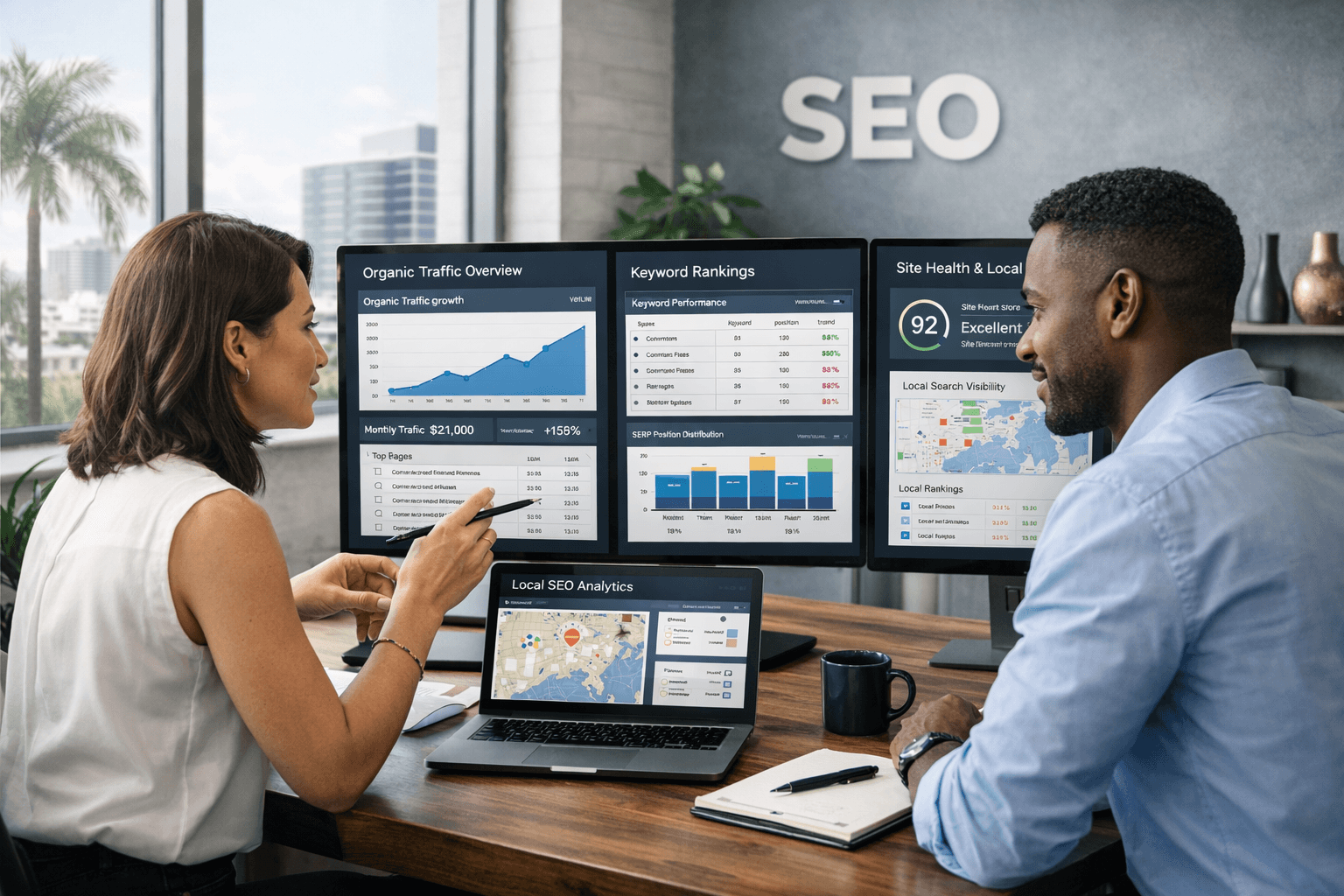
Search engine optimization gets mentioned in nearly every conversation about digital marketing, but for most business owners it stays vague — something technical that agencies do, something to do with keywords and Google, something that takes months to produce results. The vagueness is expensive. When you don’t understand what SEO actually is, you can’t evaluate whether the work being done for you is real, whether the agency managing it is doing anything meaningful, or whether the budget you’re spending is going anywhere productive.
This guide explains what SEO is, where it fits within digital marketing, and what the work actually involves — written for business owners, not developers or technical specialists.
What Is SEO?
SEO stands for search engine optimization. In practice, it’s the process of improving a website so that it appears higher in search results when someone types in a relevant query.
When someone in Miami searches “immigration attorney near me” or “best HVAC company Miami,” Google evaluates every website covering that topic and ranks them in order — the ones it judges most relevant, authoritative, and technically sound appear first. SEO is the ongoing work that moves your website up those rankings.
Unlike paid advertising, which places your business at the top of results immediately but stops the moment the budget runs out, organic SEO earns its position over time. A page that ranks well for a relevant search term generates traffic continuously, without a cost-per-click every time someone finds you.
Where SEO Fits in Digital Marketing
Digital marketing is the broad category — SEO is one channel within it. The main digital marketing channels most Miami businesses work with include:
- SEO (Search Engine Optimization): Organic search visibility built through content, technical optimization, and authority building
- Paid Search (PPC): Buying ad placements at the top of search results, paid per click when someone visits your site
- Social Media Marketing: Building audience and driving traffic through platforms like Instagram, Facebook, and LinkedIn
- Email Marketing: Communicating directly with an existing list of contacts — customers, leads, subscribers
- Content Marketing: Creating informational content — blog posts, guides, videos — that attracts and educates potential customers
- Reputation Management: Managing online reviews and controlling what appears when someone searches your business name
SEO and content marketing overlap heavily: content is one of the primary inputs that drives SEO results. SEO and paid search are often used together — paid search generates immediate traffic while SEO builds long-term organic presence. Knowing which combination fits your business and your timeline is part of what a strategic agency should tell you upfront.
The Main Components of SEO
Technical SEO
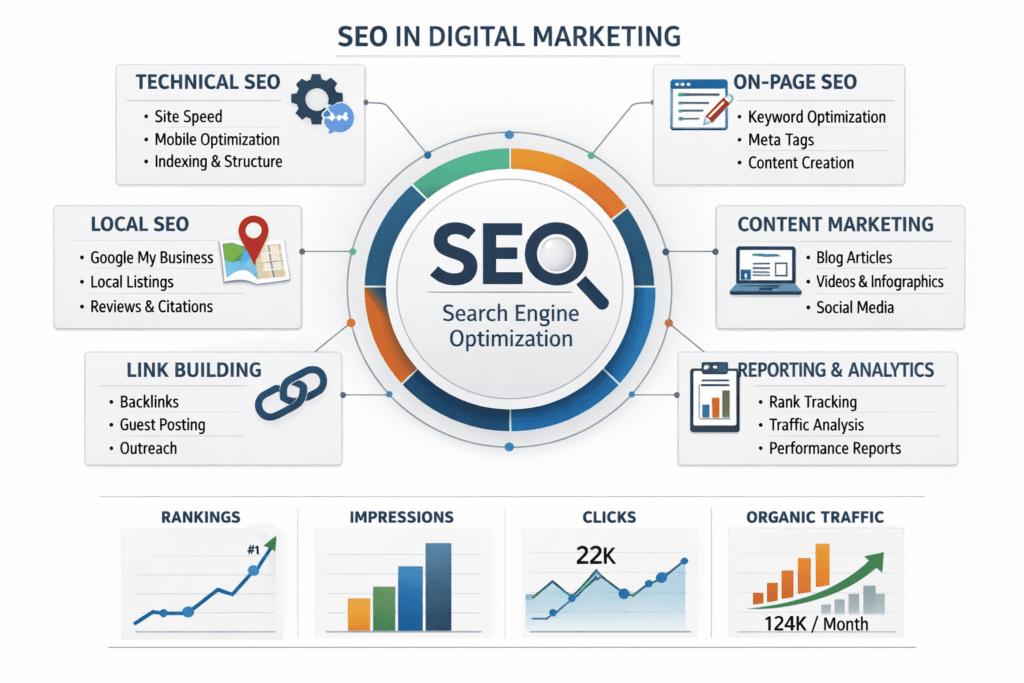
Technical SEO refers to the structural and code-level factors that affect how well search engines can crawl and understand your website. It includes page load speed, mobile usability, proper URL structure, correct use of canonical tags (telling Google which version of a page is the definitive one), schema markup (structured data that helps Google categorize your content), and crawl health — making sure Google can access and index your pages without running into errors.
Technical SEO is foundational. If Google can’t properly crawl your website, the best content in the world won’t rank. Most businesses coming to an agency for the first time have at least some technical issues — duplicate content, broken redirects, crawl errors, slow page speeds — that need to be addressed before any content or optimization work fully takes effect.
On-Page SEO
On-page SEO covers everything that happens within your actual web pages: the words, headings, images, links, and metadata. Key elements include:
- Title tags — the headline that appears in search results and browser tabs
- Meta descriptions — the brief description under the title tag in search results
- H1, H2, and H3 headings — the structural hierarchy of content on the page, which Google uses to understand topic coverage
- Body content — the actual text, which should address the topic thoroughly and include relevant keywords naturally, not artificially
- Internal links — links between your own pages that help visitors navigate and help Google understand how your site is structured
- Image alt text — descriptions that help Google understand what images show and make them accessible to all users
Local SEO
Local SEO is a specialized subset of search engine optimization for businesses that serve a specific geographic area. It focuses on appearing in Google’s local map pack — the three business listings that appear with a map at the top of local search results — as well as in organic results for location-specific queries. For any Miami business that depends on local customers, local search engine optimization is often more important than broad organic SEO.
Local SEO for a Miami business involves optimizing your Google Business Profile, building consistent citations across directories (Google, Yelp, Bing Places, Apple Maps, and industry-specific listings), managing your review profile, and creating content that explicitly references your service areas and neighborhoods — Brickell, Doral, Coral Gables, Hialeah, Aventura, Miami Beach.
Content and Link Building
Content is what gives Google something to rank. Pages with thin or generic content rarely outrank pages that address a topic with depth and specificity. Blog posts, service page copy, FAQs, and resource guides are all forms of content that support SEO results. The connection between search engine optimization and content marketing is direct: content creates pages for Google to index; SEO shapes what those pages say and how they say it.
Link building — earning links from other websites to yours — signals to Google that external sources find your content credible and useful. Links from relevant, high-quality websites carry more weight than links from unrelated or low-quality sources. Legitimate link building is earned through content worth linking to, not purchased from link farms or built through shortcuts that violate Google’s quality guidelines.
What Legitimate SEO Work Actually Looks Like
A lot of what gets sold as SEO is either superficial or counterproductive. Here’s what legitimate, professional search engine optimization services include:
- A technical audit of your website before any content or optimization work begins — finding what’s broken before building on top of it
- A clear keyword strategy that assigns specific terms to specific pages — not a list of keywords with no plan for where they go or what they support
- On-page optimization: title tags, meta descriptions, heading structure, and internal linking built around the keyword strategy
- Content creation that serves real search intent — not keyword-stuffed articles designed to game an algorithm
- Regular reporting that shows actual ranking movement and traffic data, not vanity metrics like domain authority scores that don’t connect to revenue
How Long Does SEO Take?
This is the question every business owner asks, and the honest answer is that it depends on your market, your starting point, and what the work involves. Most businesses in competitive markets start seeing meaningful ranking movement in three to six months of consistent, well-executed work.
“Meaningful” means measurable improvement in Google Search Console — higher positions, more impressions, growth in organic clicks — not necessarily page-one results on your most competitive terms in the first quarter.
Faster movement is possible when the website has a clean technical foundation, the keyword targets are in the medium-competition range rather than the most contested terms in the market, and the content and on-page work is executed correctly from the start. Slower movement — or no movement — typically happens when there are unresolved technical issues, existing spammy or hacked content that needs to be cleaned up first, or an unfocused strategy that spreads effort without building authority on any specific cluster.
SEO vs. Paid Search: Which Comes First?
Neither approach is universally better — they serve different purposes and different timeframes. Paid search generates traffic from day one. If you need leads now, it delivers immediately. The tradeoff is that it stops the moment the budget stops. SEO builds durable organic visibility. It takes longer, but once a page earns a strong ranking position, it generates traffic without an ongoing cost-per-click. See our Miami PPC and advertising services for what a well-structured paid search campaign looks like alongside SEO.
For most Miami businesses, the most effective approach combines both: paid search to capture immediate traffic while SEO builds long-term organic presence. The two channels complement each other when they’re built around a shared keyword strategy and tracked against the same conversion goals.
Want to Know Where Your Website Stands in Google?
Understanding what SEO is gets you halfway there. Knowing where your specific business falls in the rankings — and what it would take to move — is the starting point for any real strategy. We make that picture clear before you commit to anything.→ Get a free SEO audit for your Miami business and find out exactly what’s holding you back.