
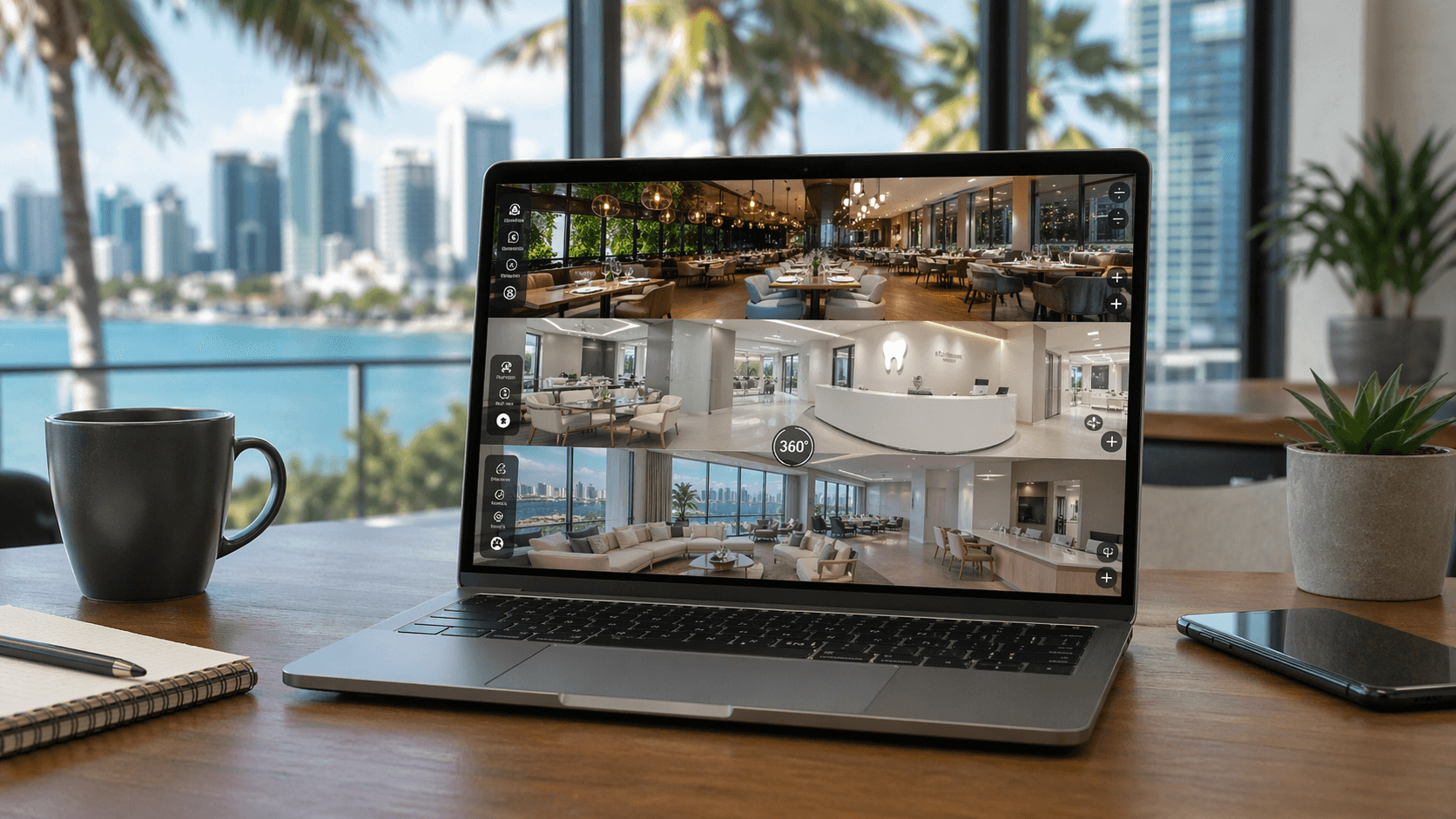
Virtual tours for Miami restaurants, medical offices, and real estate tend to pay back when the buyer has to commit before visiting — a private-event booking, a first appointment, a listing for an out-of-state buyer. They rarely pay back for walk-in concepts or commodity services. This post covers the decision framework, three verticals, and what not to expect.
When a Virtual Tour Actually Helps, and When It Does Not
A virtual tour does one specific thing well. It shortens the distance between curiosity and commitment for a buyer who cannot physically walk in before deciding. That is the whole job.
Where a tour does that job, it can reduce hesitation at the decision step. Where the buyer has no pre-commitment friction — a walk-in lunch spot, a quick-turn service, a price-led offer — the tour tends to sit on the site as a line item that gets little attention.
A rough cut: if customers typically compare options online for more than a week, travel from out of town or out of state, or sign meaningful contracts before seeing a space in person, a tour usually earns its place. If they find you on Google, drive over, and walk in, it usually does not.
The execution requirement most vendors skip
A tour only pays back when it is embedded well on the business’s own site. That means it loads quickly, works on mobile, sits where a visitor naturally finds it, and does not slow the rest of the page it lives on.
A strong production on a slow, poorly structured site is still a marketing loss. If the underlying site is the weak link, fix the site first — our web design services in Miami handle the embed and the surrounding page architecture so the tour has somewhere useful to live.
Why Most of the Miami SERP Sells Virtual Tours as a Production Service (and Why That Framing Loses Money)
Search any tour-related query in South Florida and almost every result is a production vendor — photographers, Matterport specialists, 360-video shops. The pages explain the camera, the workflow, the deliverable, and the turnaround. Most do not explain what the tour is supposed to do for the business after delivery.
That is the wrong first question. The camera is the second question.
The first question is whether buyer behavior will actually shift because of the tour. If it is likely to, the production conversation matters and you should get at least two written quotes. If it is not, the cheapest tour available is still a loss — because the loss lives in the wasted marketing attention aimed at an asset that does not convert, not in the capture itself.
Framing a tour as a production service turns it into a hardware decision. Framing it as a marketing asset makes the ROI question legible before a single photo is shot.
Miami Restaurants: What a Virtual Tour Is Actually Selling
Virtual tours for Miami restaurants are rarely about selling dinner. They tend to sell private events, reservation confidence for out-of-town guests, and pre-booking into peak windows.
What a tour sells in a restaurant context
Private dining and buyouts are the clearest payback. A corporate planner in New York or Bogotá evaluating venues for a board dinner or a post-conference reception asks for photos. A tour that shows the private room, the bar, the terrace, and the flow to the kitchen tends to answer the planner’s question in ninety seconds.
Visitor and business-traveler pre-booking is a quieter driver. Guests planning a trip a week or two out often preview restaurants before reserving, and a tour on the reservation platform or the restaurant’s own site can reduce hesitation at the booking step.
Event-weekend volume is the third. Art Basel, Calle Ocho, Boat Show, Formula 1, Super Bowl when it is in town. Restaurants that sell into these windows benefit when a remote buyer can preview the space on a Tuesday and commit on a Wednesday.
When a restaurant should invest, and when it should not
A restaurant tends to be a stronger candidate if it sells private events, buyouts, or rehearsal dinners; if a meaningful share of bookings comes from visitors planning in advance; or if it occupies a distinctive space that does not photograph well in flat stills — rooftops, multi-level layouts, courtyards, hidden rooms.
A restaurant is a weaker candidate if it runs a casual walk-in concept, a quick-service format, or a delivery-first brand. In those cases the tour is usually decoration, and the same budget tends to go further on Google Business Profile photography, reviews, and local search work.
Miami Medical and Dental Offices: Reducing the First-Visit Friction
The medical and dental job is different. A tour does not sell a procedure. It lowers the anxiety of a first visit enough that a hesitant patient is more likely to finish the booking.
The Miami-Dade market shapes this. Cosmetic, aesthetic, dermatology, cosmetic dentistry, MedSpa, and concierge medicine verticals are dense and discretionary — patients routinely pre-screen practices before a first appointment. A tour that shows a clean, well-lit reception area and a quiet, professional exam room answers a private question most patients will not ask aloud: is this going to feel like a good place to walk into? Concierge and specialty practices also see cross-border patient flow from Latin America and the Caribbean, where a tour plays a similar pre-screening role.
HIPAA-safe framing is non-negotiable
A tour of a medical or dental office should show the physical space only. It should not show patients, patient faces, identifiable patient materials, charts, screens displaying patient information, or any clinical detail that could identify an individual.
In practice, that means capturing during off-hours, removing visible patient material from reception and treatment rooms before the shoot, and reviewing the finished tour before it publishes. This is general guidance, not legal advice — each practice should confirm specific production and publication choices with its own compliance counsel.
Which practices benefit most, and which tend not to
Stronger fits include plastic surgery, dermatology, cosmetic dentistry, orthodontics, MedSpa and aesthetics, concierge medicine, fertility, and specialty practices that attract cross-state or international patients.
Weaker fits include high-volume primary care, urgent care, and any practice whose booking decision is driven mostly by insurance network and availability rather than shopping behavior. In those settings patients tend to choose on coverage and convenience, and a tour is unlikely to shift the decision.
Miami Real Estate and Showrooms: Cross-Border Buyers and the Remote-Showing Workflow
Miami real estate is one of the clearer fits for the framework, because the buyer pool is disproportionately not local. Virtual tours of homes in South Florida condo inventory do a disproportionate share of the pre-offer work.
Why cross-border buyer flow changes the ROI math
A meaningful share of Miami buyers are international — Argentina, Venezuela, Colombia, Brazil, Mexico, Canada, parts of Europe — and a second meaningful share are domestic out-of-state buyers from the Northeast US and Chicago. For those buyers, a tour is how a serious prospect qualifies a property before a flight.
That reframes what the tour is for. It is not a marketing asset; it is a pre-qualification asset. Listings with strong tours tend to attract more serious remote inquiries, while listings without them tend to see less engagement from the remote-buyer segment.
Brickell, Aventura, Sunny Isles, and Miami Beach patterns
High-rise condo submarkets in Brickell, Aventura, Sunny Isles, and Miami Beach hold large inventory of near-identical floor plans. A remote buyer comparing three units in the same building often struggles to distinguish them from listing photos alone, and a tour tends to do that work. On higher-end units, the production quality also has to meet the brand’s luxury floor — a low-light or low-resolution capture on a high-end listing can read worse than no tour at all.
Showroom use — furniture, marine, luxury retail
The same logic extends to showrooms. Yacht dealers in Fort Lauderdale, furniture showrooms serving designers, and luxury retail rooms that sell to geographically distant buyers all see a version of the real-estate math. The buyer is weighing a significant purchase from another city or country, and the tour is the preview that informs whether a trip is worth taking.
Realistic ROI and a Simple Decision Framework
Most of the ROI question comes down to four criteria. A yes on two or more tends to signal a tour is worth commissioning. A no on three of four usually signals it is a vanity purchase.
1. Average transaction value. The higher the per-customer or per-sale value, the easier the tour pays back. A twenty-five-dollar lunch does not justify it. A multi-thousand-dollar private-event booking, a cosmetic-dentistry treatment plan, or a seven-figure condo listing generally does.
2. Pre-commitment friction. How much does the buyer need to see, feel, or verify before saying yes? High friction — a medical first visit, a real-estate offer, a private-event buyout — is where a tour tends to earn its money. Low friction is where it does not.
3. Geographic buyer spread. The more remote the buyer pool, the more a tour matters. South Florida’s cross-border flow tilts this criterion in favor of tours for any vertical with meaningful out-of-state or international demand.
4. Asset lifecycle. How long will the tour stay accurate? A restaurant that renovates every two years, a clinic that moves suites, or a listing that sells in sixty days all shorten the payback window. A stable space with a three-to-five-year horizon makes the math easier.
If your vertical and your numbers line up, our Miami virtual tour team handles the production, the embed, and the surrounding marketing decisions as one engagement — which is the part most production-only vendors leave to the client.
What Not to Expect from a Virtual Tour
A tour is one asset in a larger marketing stack. It does a specific job well and a long list of other jobs poorly. To keep expectations honest:
- It will not rescue a business whose core offering is the real issue. If the product, service, or reviews are the problem, a tour will not solve for those.
- It will not replace local search, Google Business Profile work, or reputation management. Those channels are how you get found; the tour is what happens once the prospect is already looking.
- It will not directly improve Google rankings. It can support engagement signals on your profile and site, but a tour on its own is not a ranking lever.
- It will not go viral. Tours are decision aids, not social content.
- It will not substitute for site quality. Embedded on a slow or poorly built site, the tour tends to underperform.
- It will not stay accurate forever. Renovations, menu changes, suite moves, and storm-season facade damage all age a tour. Price a reshoot cadence into the decision.
- It will not work without a reason to be there. If the page the tour lives on has no clear next step — reserve, book, contact, tour in person — the asset is orphaned.
FAQ
Do virtual tours actually help Miami businesses, or are they a photography expense?
They tend to help when the buyer has to commit before visiting — a private-event booking, a first medical or dental appointment, a real-estate listing for an out-of-state buyer. In those settings the tour reduces pre-commitment friction. For walk-in concepts, commodity services, and price-led offers, a tour is usually a line item that does not change buyer behavior.
Which Miami businesses get the most value from a virtual tour?
Three verticals tend to benefit most: restaurants selling private events and reservation-heavy experiences, medical and dental practices where first-visit anxiety affects booking, and real-estate listings with a meaningful out-of-state or international buyer pool. Showrooms that sell to geographically distant buyers — furniture, marine, luxury retail — follow similar logic and often see meaningful ROI.
How much does a Miami virtual tour cost, and what does the investment usually include?
Production packages generally range from a few hundred dollars for a small single-space shoot to several thousand for multi-room captures with floor plans, custom branding, and embedded hotspots. Specific pricing varies by vendor and scope, so obtain at least two written quotes before committing and confirm exactly what is included in each.
Do virtual tours show up on Google Business Profile, and does that help local search?
Yes — virtual tours can appear on a verified Google Business Profile and through embedded content on the business’s own site. Presence on its own is not a ranking guarantee, but tours can support engagement signals such as time on listing and click-through to the site, which contribute to overall profile completeness.
Can a virtual tour help a Miami real estate listing sell faster?
In Miami, where out-of-state and international buyer flow is heavy, a well-made virtual tour can reduce the time a serious buyer needs before making an offer, because it lets them qualify a property without flying in. Specific faster-sale percentages do appear in industry publications, but each figure should be verified against the original cited study before being repeated in marketing.If your vertical and your numbers line up with the framework above, the next step is to decide whether to run the production yourself, hire a local photographer, or bring in a Miami virtual tour company that handles the strategy, the capture, and the embed as one engagement. A short call is usually enough to know which of those three paths fits.